 Moteur Volcan
Moteurs EC à rotor intérieur et à rotor extérieur
Inner Rotor vs. Outer Rotor EC Motors: A Practical Engineering Guide
If you’re specifying an EC motor, one of the first decisions you’ll face is rotor placement. Inner rotor or outer rotor? The choice affects torque output, plage de vitesse, thermal management, control complexity, et fiabilité à long terme.
This guide breaks down the key differences. By the end, you’ll have the data you need to make an informed decision.
Inner vs. Outer Rotor: Which Mechanical Design Fits Your Application?
The difference is simple: in an inner‑rotor motor, the rotor spins inside the stator; in an outer‑rotor motor, the rotor surrounds the stator and rotates on the outside. That simple distinction has major mechanical implications.
Inner‑Rotor (Inrunner)

The rotor sits inside the stator winding, with a relatively small diameter. Heat dissipates outward through the stator and housing. Inner‑rotor motors generally have lower inertia and can achieve higher rotational speeds.
Shaft is the rotating element; stator is on the outside
Bearing layout: two bearings (front and rear) supporting the shaft
Moment of inertia: lower → faster acceleration/deceleration
Simpler sensor mounting (encodeur, Hall sensors on the shaft)
Outer‑Rotor (Outrunner)
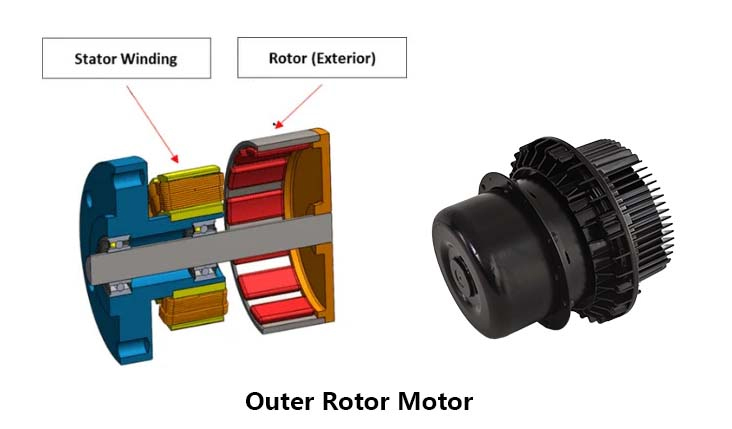
The rotor is on the outside, with a larger effective radius and longer torque arm. The stator is fixed to a central shaft; the rotating outer shell typically incorporates cooling fins or a fan blade.
Rotating shell is the output; stator is fixed on a central shaft
Bearing layout: often a single large bearing or two bearings supporting the shell
Moment of inertia: significantly higher (mass at larger radius)
Direct‑drive capable: rotor shell can directly drive a fan impeller or wheel
Sensor mounting is trickier (sensors need to mount on stationary shaft)
Integration risks to watch:
Outer‑rotor: requires careful axial clearance; alignment is more critical
Inner‑rotor: simpler sensor mounting; easier bearing replacement
Couple, Vitesse, and Inertia: How Rotor Type Affects Dynamic Performance
Torque‑speed characteristics differ significantly because of one physical principle: Torque = Force × Radius.
Torque Density and Output
Outer rotor motors have a larger effective radius, so they produce higher torque for the same volume. The torque constant (Kt) is inherently higher.
| Paramètre | Inner Rotor | Outer Rotor |
| Torque density | Modéré | Plus haut |
| Torque constant (Kt) | Inférieur | Plus haut |
| Speed range | Plus haut | Inférieur (1,500–3,000 RPM typical) |
| Acceleration | Faster (lower inertia) | Slower |
| Gravimetric power density | Plus haut (if run at high speed) | Inférieur |
Inner‑rotor achieves competitive power density at high speed; outer‑rotor delivers high torque at low speed, often eliminating the need for a gearbox.
Practical example – same volume, same power:
Inner rotor: 0.5 Nm, 3000 RPM → 157W
Outer rotor: 1.5 Nm, 1000 RPM → 157W
Outer rotor gives 3× the torque at 1/3 the speed — ideal for direct‑drive.
Thermal Management and Efficiency: Which Rotor Runs Cooler Under Load?
Thermal behavior is a key differentiator — and often overlooked in vendor literature.
Heat Path and Dissipation
| Aspect | Inner Rotor | Outer Rotor |
| Stator heat path | Short, direct to housing | Long, through air gap to rotor |
| Rotor cooling | Poor (trapped inside) | Excellent (outer surface exposed) |
| Continuous power capability | Limited by stator heat | Plus haut (better dissipation) |
| Thermal time constant | Shorter | Longer (larger thermal mass) |
| Efficiency at rated point | Often slightly higher | Slightly lower |
| Part‑load efficiency | Drops more | Maintains better |
Outer rotor configurations have superior nominal torque because of better heat dissipation. Inner rotor constructions have higher output power and torque.
Cooling strategies:
Natural convection: both, but outer‑rotor benefits from rotating shell moving air
Forced air: outer‑rotor can integrate fan blades into the rotor
Liquid cooling: more common on inner‑rotor (stator can be jacketed)
Loss breakdown:
Copper losses (I²R): higher in outer‑rotor (longer end turns)
Iron losses: higher in outer‑rotor (larger diameter, more material)
Windage: higher in outer‑rotor (rotating shell moves more air)
Derating example: A 1kW inner‑rotor motor at 25°C ambient might derate to 0.7kW at 50°C. An outer‑rotor with the same rating might only derate to 0.85kW.
Control Electronics and Sensors: What to Watch For in EC Motor Drives
Control requirements differ and affect driver selection, sensor choice, and system integration.
| Aspect | Inner Rotor | Outer Rotor |
| Sensorless (back‑EMF) | Works well medium‑high speed | Works well, but low‑speed detection harder |
| Hall sensors/encoders | Easier to mount (rotor on shaft) | More complex (mount on stationary shaft) |
| Back‑EMF waveform | More sinusoidal | More trapezoidal |
| Controller tuning | FOC preferred | Six‑step or FOC both work |
Practical controller selection:
Inner rotor + grande vitesse: sensorless FOC works well
Inner rotor + basse vitesse + position control: encoder recommended
Outer rotor + direct drive: sensorless FOC works down to moderate speeds
Outer rotor + basse vitesse + high torque: Hall sensors or encoder recommended
Noise and Reliability: Which Rotor Type Runs Quieter and Lasts Longer?
Final decisions often come down to noise, vibration, fiabilité, and total cost.
Bruit et vibrations
| Aspect | Inner Rotor | Outer Rotor |
| Noise level | Can be noisier | Quieter generally |
| Vibration | Inférieur | Higher potential (large rotating mass) |
| Acoustic signature | Higher‑frequency whine | Lower‑frequency hum |
Outer rotor motors are generally quieter but can have vibration issues at resonant frequencies. Inner rotor motors tend to run smoother.
Reliability and Maintenance
| Aspect | Inner Rotor | Outer Rotor |
| Bearing life | 20,000–50,000 hours | 20,000–50,000 hours |
| Bearing replacement | Easier | More complex |
| Contamination risk | Inférieur | Plus haut (shell exposed) |
| Typical maintenance | Bearing replacement 3‑5 years | Bearing replacement, rotor cleaning |
Real-World Applications: Where Inner and Outer Rotor Motors Win
Theory is useful, but real‑world applications tell the real story. The two examples below show how the rotor choice plays out in practice. At the end of this section, you’ll find a quick reference guide to help match each rotor type to common applications.
Example 1: Livestock Ventilation Fans – Outer Rotor Delivers Durability and Energy Savings
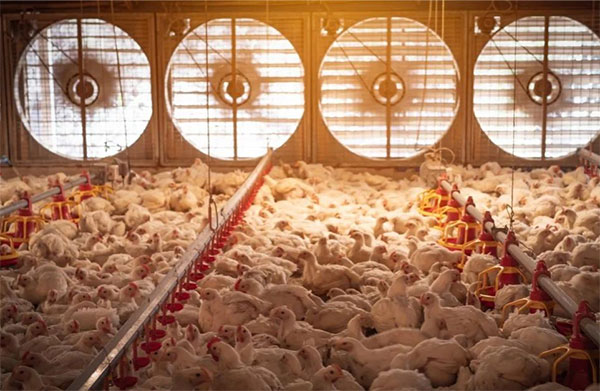
Large livestock operations – poultry houses, swine barns, and dairy facilities – depend on continuous ventilation to maintain air quality, control temperature, and remove harmful gases like ammonia. The fans often run 24/7, making energy efficiency and reliability top priorities. Traditionally, these barns used AC motors with belt drives. But belts wear out, need regular tensioning, and lose efficiency over time. In a dusty, ammonia‑rich environment, belts and bearings degrade faster, increasing maintenance costs and downtime.
The solution: UN 38 inch ventilation fan powered by an outer rotor EC motor, operating at speeds from 20% à 100% with variable speed control. The motor’s IP55 protection rating withstands the harsh agricultural environment – dust, humidité, and ammonia exposure. By eliminating belts, pulleys, and tensioning devices, the direct‑drive design removes the most common failure points in barn ventilation systems.
A key advantage: The outer rotor direct drive design removes belts and pulleys entirely, eliminating the most common failure points in barn ventilation while delivering up to 48.6% energy savings over traditional AC fan motors. In a German poultry farm case study, replacing conventional fans with EC motor‑driven units reduced the monthly electricity bill by 35%. In another installation, a U.S. farm achieved savings of over 48%. The quiet operation also reduces animal stress, a factor that directly impacts feed conversion and productivity. With fewer moving parts and no belts to replace, maintenance intervals extend significantly, and the motor’s expected lifespan comfortably exceeds 10 years of continuous service.
Key takeaway: Outer‑rotor EC motors are the natural fit for livestock ventilation – they eliminate belt maintenance, withstand harsh barn environments, and cut energy consumption by 35–48% compared to conventional AC fan motors. In applications where fans run 24/7 and reliability is non‑negotiable, the outer‑rotor configuration delivers the lowest total cost of ownership.
Example 2: Small Pumps – Inner Rotor Enables Variable-Speed Efficiency
A commercial building HVAC system needed a vertical multistage centrifugal pump for cold water circulation in a large office complex. The pump needed to operate efficiently across varying demand – from low flow at night to peak flow during business hours – while maintaining reliable operation and integrating with the building automation system.
Traditional fixed-speed pumps waste energy by running at full speed regardless of demand. The building owner wanted a variable-speed solution that could match pump output to actual cooling load without adding external VFDs and the associated space and wiring costs.
The solution: A centrifugal pump with an IE5 EC motor and an integrated, air-cooled frequency converter. The pump uses an inner-rotor EC motor that allows variable-speed operation across five different control modes: differential pressure constant, differential pressure variable, pressure constant, constant speed, and PID control.
A key advantage:The IE5 motor efficiency and integrated frequency converter work together to deliver substantial energy savings across the entire operating range. Because pump power scales with speed, the variable‑speed capability reduces energy consumption by 30–50% compared to fixed‑speed operation. The integrated converter eliminates the need for an external VFD cabinet, simplifying installation and saving mechanical room space. Built-in protective functions-dry-running detection, thermal protection, and fault diagnostics – further reduce system complexity.
Key takeaway: Inner-rotor EC motors with integrated drives enable compact, efficient variable‑speed pump packages. The small rotor diameter keeps the motor package size manageable, and the integrated converter simplifies installation. IE5 efficiency ensures the lowest possible energy consumption, making these pumps ideal for HVAC circulation, water supply, and industrial process applications.
Quick Reference: Which Rotor Type Fits Your Application?
Need Help Selecting the Right Motor?
Choosing between inner and outer rotor EC motors isn’t about which is “better” — it’s about which fits your torque‑speed profile, thermal environment, space, and budget.
We’re a Chinese manufacturer offering a full range of EC motors. Whether you need a compact inner rotor motor, or a outer rotor motor, we’ve got you covered.
If you have a project in mind or just want to talk through the options, reach out.
Contact us for a free engineering consultation: info@volcaomotors.com
FAQ
T1: What are the mechanical differences between inner‑rotor and outer‑rotor EC motors?
A1: Inner‑rotor: rotor spins inside stator on central shaft. Outer‑rotor: rotor surrounds stator. Outer‑rotor has larger radius, higher inertia, and direct‑drive capability.
T2: Which rotor type is better for low‑speed, high‑torque or direct‑drive applications?
A2: Outer rotor. The longer torque arm delivers high torque at low speed and eliminates the need for a gearbox.
T3: How do cooling requirements differ?
A3: Outer‑rotor has better heat dissipation (rotating shell acts as heat sink). Inner‑rotor has shorter stator heat path but poor rotor cooling. Outer‑rotor generally handles continuous duty better.
T4: What controller and sensor considerations should I account for?
A4: Both support sensorless FOC, but low‑speed operation favors Hall sensors or encoders. Outer‑rotor sensor mounting is more complex; inner‑rotor is simpler. Outer‑rotor back‑EMF is often more trapezoidal.
Q5: How do noise, vibration, maintenance, and lifecycle costs compare?
A5: Outer‑rotor is generally quieter but can vibrate at resonance. Bearing life is similar; replacement is harder on outer‑rotor. Inner‑rotor has lower upfront cost; outer‑rotor often has lower TCO in direct‑drive applications (no gearbox).