 Moteur Volcan
Ventilateurs centrifuges EC pour le séchage des grains: Flux d'air plus intelligent, Réduire les factures d'énergie
Si vous stockez du grain sur votre ferme, tu connais le rythme de la récolte: les moissonneuses-batteuses roulent, les poubelles se remplissent, et les fans commencent à courir. Those fans might run for days or weeks at a time, pushing air through thousands of bushels of corn, soybeans, or wheat to bring moisture down to safe storage levels.
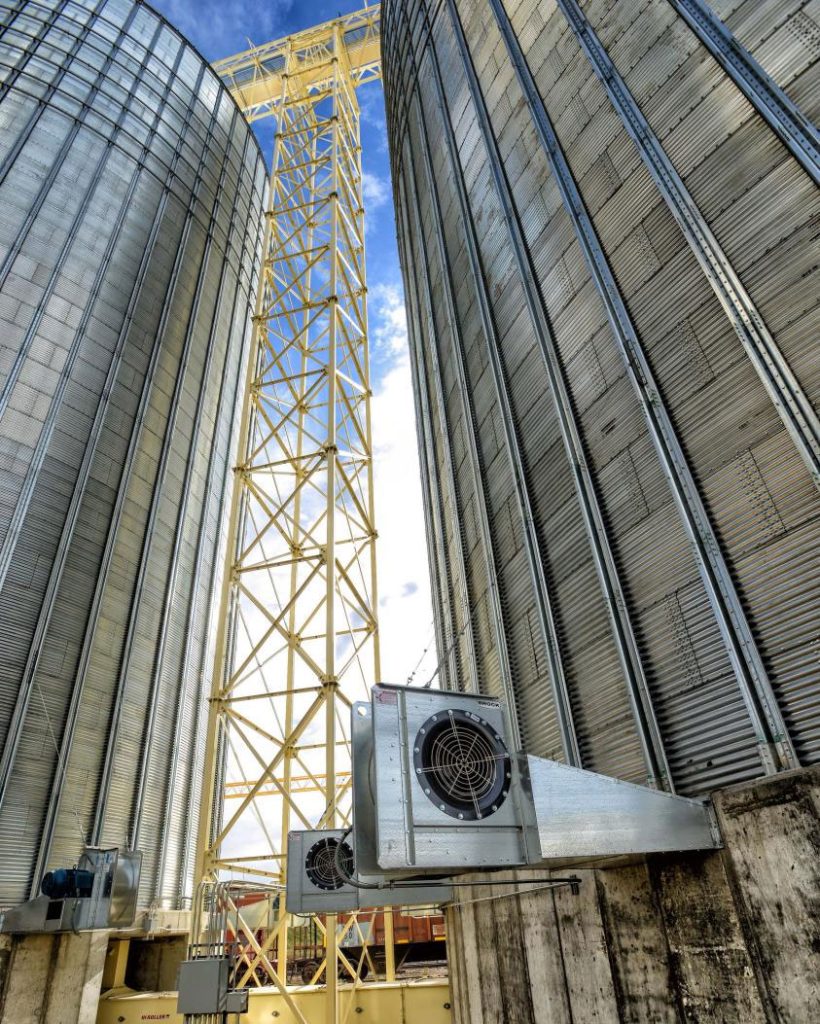
What you may not realize is just how much those fans are costing you. In many grain drying operations, fans account for 40–60% of total electrical load. A typical 25 hp aeration fan running 2,000 hours per year can consume over 37,000 kWh-enough electricity to power three average U.S. homes for a year.
With electricity rates averaging 12-15 cents per kWh and rising, that adds up quickly. For a farm with multiple bins, annual fan electricity costs can easily reach$5,000–$10,000 or more.
En même temps, drying quality has never been more important. Over-drying wastes energy and reduces your grain weight at the scale. Under-drying invites spoilage, dockage, and lost revenue. And the window for getting grain dry is tight-especially during the humid fall season.
That’s where EC centrifugal fans come in. EC stands for electronically commutated-a technology that integrates a brushless DC (BLDC) motor with a dedicated controller in one compact unit. This integrated design delivers30–50% less energy consumption, more uniform drying, and payback periods as short as 2–3 années.
Here’s what grain producers need to know about selecting, sizing, and benefiting from EC centrifugal fans.
Why Grain Depth and Crop Type Change the Fan You Need
Pushing air through 20 feet of corn is nothing like moving air through an empty warehouse. Each kernel adds resistance, and the deeper the grain bed, the harder the fan has to work.Static pressure -measured in inches of water column (in. w.g.)-is the force your fan must generate to overcome this resistance.
Centrifugal fansare uniquely suited for this challenge. Unlike axial fans that excel at moving high volumes of air at low pressure, centrifugal fans are designed to generate the high static pressures required for deep grain beds. They convert rotational energy into pressure by accelerating air outward through an impeller-making them the preferred choice for drying applications where static pressures exceed 4 in. w.g.
The three factors driving your static pressure requirement:
| Factor | Impact on Static Pressure |
| Grain type | Corn offers higher resistance than soybeans; wheat falls in between |
| Grain depth | Pressure increases roughly linearly with depth |
| Airflow rate | Higher cfm/bu = higher resistance |
A practical example: A 36-foot diameter bin filled with corn to 20 feet, dried at 1.0 cfm/bu, typically requires 4-5 inches w.g. of static pressure. An axial fan would lose significant airflow at this pressure; a properly sized centrifugal fan delivers its rated airflow right at this operating point.
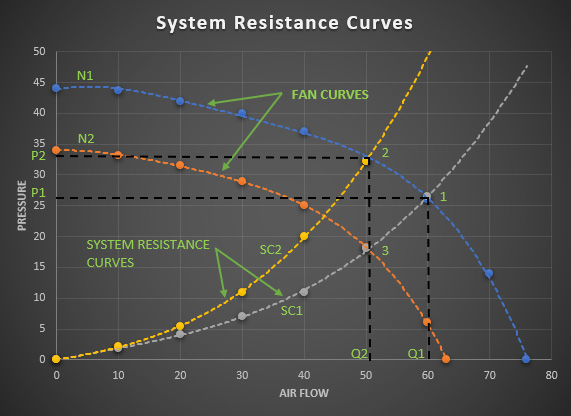
The key to correct selection is matching the fan performance curve to your bin’s system resistance curve. Where these two curves intersect is where your fan will actually operate-not at its maximum airflow rating on the spec sheet.
EC vs. AC Induction: What Makes the Motor Matter
Here’s where the technology story gets interesting-and where the energy savings start to add up.
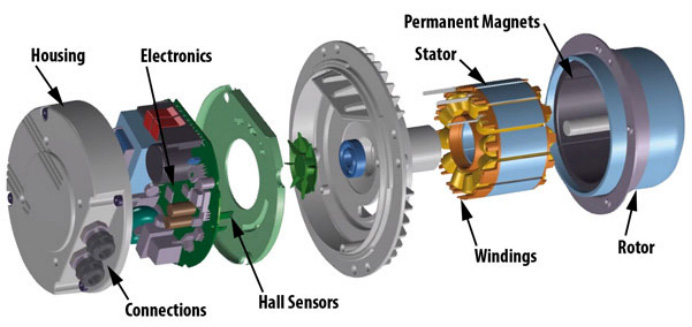
Moteurs EC (commutation électronique) are fundamentally different from traditional AC induction motors. The rotor usespermanent magnetsinstead of induced currents, and the integrated controller precisely manages the commutation. This is where the efficiency gain comes from.
The Efficiency Gap
| Type de moteur | Typical Efficiency | Efficiency at Partial Load |
| CE (BLDC with integrated drive) | 85-90% | Remains high across entire speed range |
| Three-phase AC induction | ~75% at full load | Drops significantly when slowed |
| Single-phase AC induction | 50-60% | Poor; often unusable at reduced speed |
What this means in practice: An EC motor system delivers approximately40% power savingscompared to a single-phase AC induction motor of equivalent output. For a 25 hp drying fan running 2,000 hours per year, that’s over$2,000 in annual electricity savingsat typical farm rates.
Variable Speed–The Game Changer
AC induction motors are designed for a single operating speed. Run them slower-which you might want for overnight aeration or low-temperature drying-and efficiency drops sharply. EC motors maintain high efficiency across their entire speed range. An EC fan can deliver anywhere from 20% à 100% of rated airflow, with near-constant efficiency across that range.
Integrated Control: Simplicity and Reliability
Because EC fans come with a built-in controller, there’s no need to purchase and mount a separate VFD (variable frequency drive). The controller handles speed regulation, soft starting, and protection features internally. This integrated approach reduces wiring complexity, saves panel space, and eliminates compatibility issues between motor and drive.
Power Factor and Farm Electrical Systems
For facilities operating on single-phase or three-phase power, EC drives offer another advantage: built-in power factor correction. Induction motors draw reactive current, causing voltage drop on long lines. EC drives draw current more efficiently-more of your electricity bill goes to actual drying, less is wasted as heat in the wires.
Fonctionnement plus silencieux
EC motors run with significantly lower audible noise than comparable AC induction motors. For grain bins located near farmhouses or livestock facilities, this is a real improvement in quality of life during harvest.
Sizing Your Fan for Uniform Drying: From Moisture Target to Airflow Requirement
Choosing the right fan starts with a single calculation: how much airflow do you need?
Étape 1: Determine Target Airflow (cfm/bu)
Recommended airflow rates for natural-air drying:
| Crop | Max Moisture for Natural Drying | Minimum Airflow |
| Corn | 21% | 1.0 cfm/bu |
| Soybeans | 17% | 0.75-1.0 cfm/bu |
| Wheat | 17% | 0.75 cfm/bu |
| General natural drying range | – | 0.75-1.5 cfm/bu |
Example: A 10,000-bushel bin of corn at 20% moisture needs at least10,000 cfm (10,000 bu × 1.0 cfm/bu).
Étape 2: Estimate Static Pressure
Using ASABE D272.3 resistance tables:
- Corn at 20 feet depth: ~3-5 in. w.g.
- Soybeans: Generally lower resistance than corn
- Wheat: Resistance falls between corn and soybeans
Étape 3: Select the Fan
Choose a centrifugal fan where the performance curve intersects your bin’s system resistance curve at or above your required airflow. Fan selection software-available from most manufacturers or through Extension services-can help you plot this accurately.
Why Uniform Drying Matters
Uneven airflow through the grain bed leads to:
- Over-drying near the air inlet (weight loss, quality reduction)
- Under-drying in dead zones (spoilage risk)
- Increased drying time and energy waste
Centrifugal fans with properly designed impellers and housings deliver more uniform airflow across the full bin diameter than axial fans-particularly at the higher static pressures typical of deep grain beds.
Total Cost of Ownership: Why Higher Upfront Cost Pays Off Over Time
EC centrifugal fans cost more upfront-typically 30-50% more than an equivalent AC fan. But the total cost of ownership tells a different story.
Maintenance Savings
| Composant | AC Fan | EC Fan |
| Brushes | Replace periodically | None-brushless design |
| Bearings | 20,000-30,000 heures | 50,000+ heures (sealed ball bearings) |
| Belts | Replace every 1-2 années | None (direct-drive models) |
| Capacitors | Replace periodically | None |
| External VFD | May be required | Integrated-no separate drive |
| Annual maintenance cost | Plus haut | Minimal |
Économies d'énergie: A Real-World Example
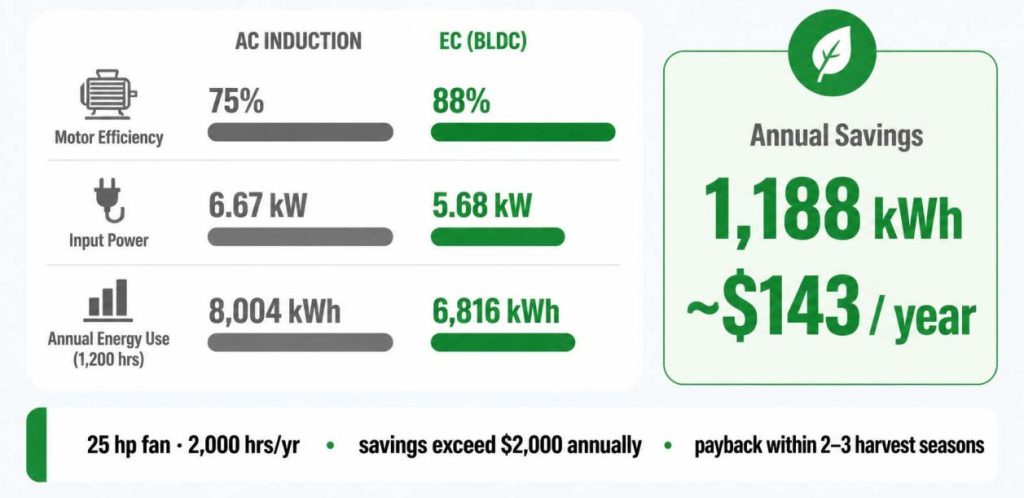
| Metric | AC Induction | CE (BLDC) |
| Motor efficiency | 75% | 88% |
| Input power required | 6.67 kW | 5.68 kW |
| Annual energy use (1,200 hrs) | 8,004 kWh | 6,816 kWh |
| Annual savings | 1,188 kWh / ~$143 |
Scale this to a 25 hp fan running 2,000 hours per year: energy savings exceed$2,000 annually-enough to recover the higher initial cost within 2–3 harvest seasons.
Ready to Upgrade?
The harvest season moves fast-and every day of delayed drying costs money. EC centrifugal fans offer a proven path to faster, more uniform drying with significantly lower energy costs.
Your action plan:
- Measure your bin -diamètre, grain depth, and typical fill volume
- Calculate required airflow -multiply bushel capacity by target cfm/bu (1.0 cfm/bu for natural-air corn drying)
- Estimate static pressure -use ASABE D272.3 tables for your crop and depth
- Check your power -single-phase or three-phase? Tension?
- Assess retrofit potential -can your existing fan housing accommodate an EC motor?
- Calculate TCO -energy savings + maintenance reduction + available incentives
- Schedule a site assessment -have a qualified technician verify fan sizing and electrical compatibility
Need help with specific calculations or site evaluation? Please inform our engineering team of your hopper size, crop type, and power availability at info@volcanomotors.com and we will help you match the right EC configuration.
FAQ
T1: How do EC centrifugal fans improve energy efficiency compared to traditional AC induction fans in grain drying?
A1: Moteurs EC (BLDC with integrated drive) achieve 85-90% efficiency across their entire speed range, compared to 50-75% for AC induction motors. At the same airflow and static pressure, EC centrifugal fans typically consume 40-50% less power. An EC system delivers approximately 40% power savings over single-phase AC induction.
T2: What static pressure should I plan for when drying corn in a typical grain bin, and how does that affect fan choice?
A2: For corn at 20+ feet depth, expect static pressure of 3-5 inches w.g.. Centrifugal fans are more efficient above 4 inches w.g. and are the recommended choice for deep bins. Always match the fan performance curve to your bin’s system resistance curve-don’t select based on maximum airflow alone.
T3: How does variable speed control on an EC fan help maintain uniform grain moisture and prevent over-drying?
A3: Variable speed allows the fan to match airflow to actual drying needs. When moisture approaches target, the fan slows to prevent over-drying. When outside humidity is high, the fan reduces speed to avoid adding moisture. Automated control via temperature and humidity sensors maintains uniform moisture across the bin.
T4: What airflow rate per bushel is recommended for drying soybeans or wheat, and how do I size a centrifugal fan from that?
A4: For natural-air drying: soybeans require 0.75-1.0 cfm/bu(jusqu'à 17% humidité); wheat requires at least 0.75 cfm/bu(jusqu'à 17% humidité). Multiply cfm/bu by total bushels, then select a fan whose performance curve meets that airflow at your bin’s static pressure.
Q5: What maintenance and bearing inspection intervals are typical for EC centrifugal fans used in grain drying?
A5: Quality EC fans use sealed ball bearings rated for 50,000 hours at 25°C. With no brushes to replace, no belts (on direct-drive models), and no external VFD to maintain, maintenance is minimal. Annual inspection of bearings, impeller balance, and controller heatsink cleanliness is recommended. In dusty grain environments, keep the controller’s cooling fins clear of debris.