 Мотор вулкан
Greenhouse Negative Pressure Fans: How to Match Fan Size, Airflow, and Motor Power
A greenhouse negative pressure fan is one of those components that seems simple until you have to specify one. The catalog says 20,000 CFM. The price looks right. You install it, and the greenhouse still runs hot in July.
The problem is almost never the fan itself. It’s the match between fan, мотор, and the actual operating conditions of the greenhouse.
This guide is written for two groups of people: the manufacturers who build greenhouse negative pressure fans, and the growers, contractors, and procurement teams who buy them. The focus is on the fan system – расход воздуха, static pressure, and motor selection. But we’ll also explain why EC motors have become the technology that separates a fan that works on paper from a fan that works in a greenhouse.
We make EC motors for ventilation fans. But the fan is the product. The motor is what determines whether the fan delivers its rated performance after installation.
The 3 Parameters That Define a Greenhouse Fan
Greenhouse ventilation is a system: фанаты, inlets, and static pressure all affect each other. You can’t evaluate a fan in isolation.
Three parameters determine whether a negative pressure fan will actually perform:
1. Airflow: sized by greenhouse volume, not floor area alone.
A common guideline for maximum air exchange in a greenhouse is 8-10 CFM per square foot of floor area. But that guideline assumes standard ceiling heights. For a greenhouse with a taller ridge, volume-based sizing is more accurate.
The ventilation rate for a greenhouse is typically calculated as:
Total airflow (CFM) = Greenhouse volume (ft³) × Air changes per hour ÷ 60
For summer cooling, greenhouses generally target 30-60 air changes per hour depending on climate and crop sensitivity. For moisture control in winter, minimum ventilation is typically around 1 air change per hour.
2. Статическое давление: the number most fan catalogs don’t show you.
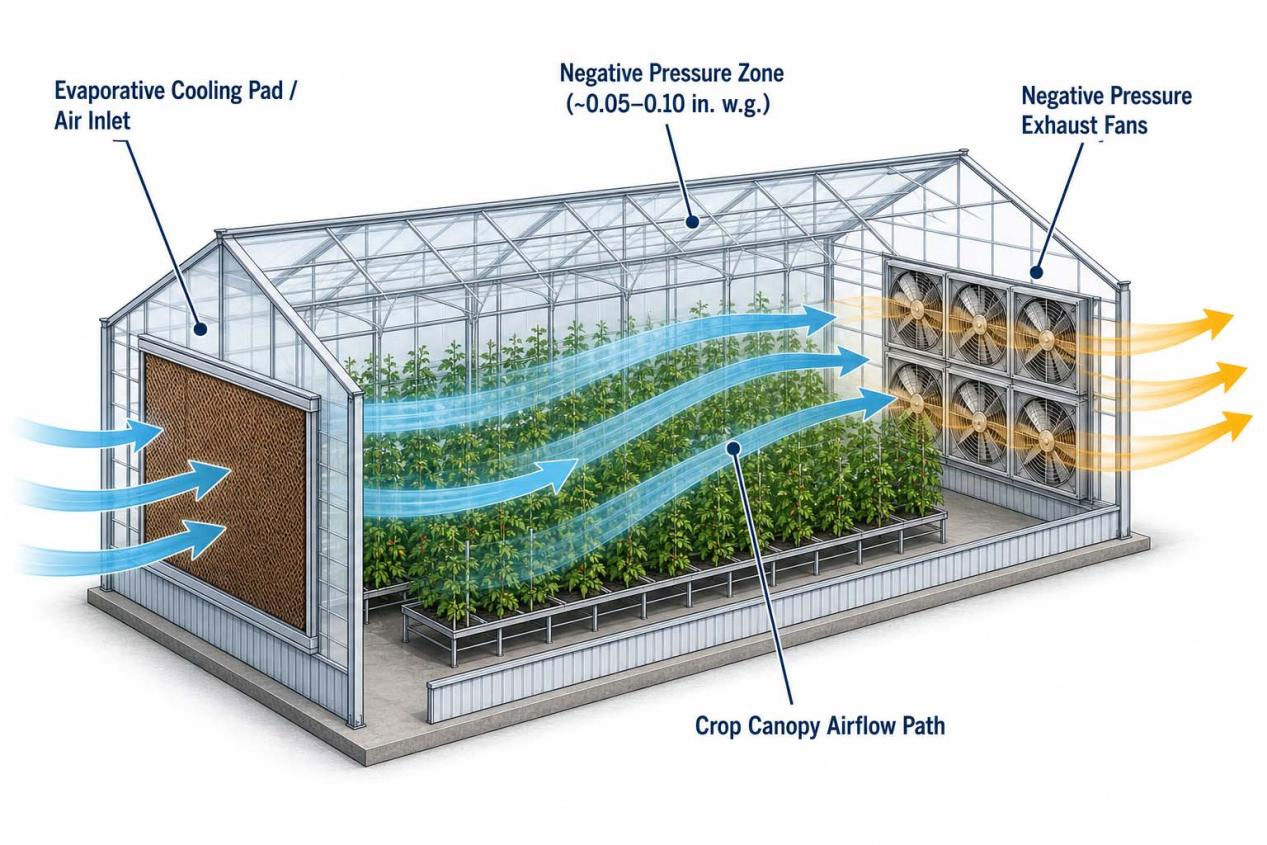
This is the parameter that causes the most disappointment after installation. Greenhouse ventilation fans are designed to operate at approximately 0.05 inches of water static pressure, with an acceptable range of 0.03-0.13 inches. For initial estimates, evaluate fan performance at 0.10 or 1/8-inch static pressure.
Why does this matter? Because a fan rated at zero static pressure can lose 10-15% of its airflow when installed with shutters, guards, and evaporative cooling pads in the airflow path. If the catalog only gives you zero-static airflow, that number is essentially fiction for greenhouse applications.
3. Motor power: derived from torque at the operating speed, not copied from the old motor.
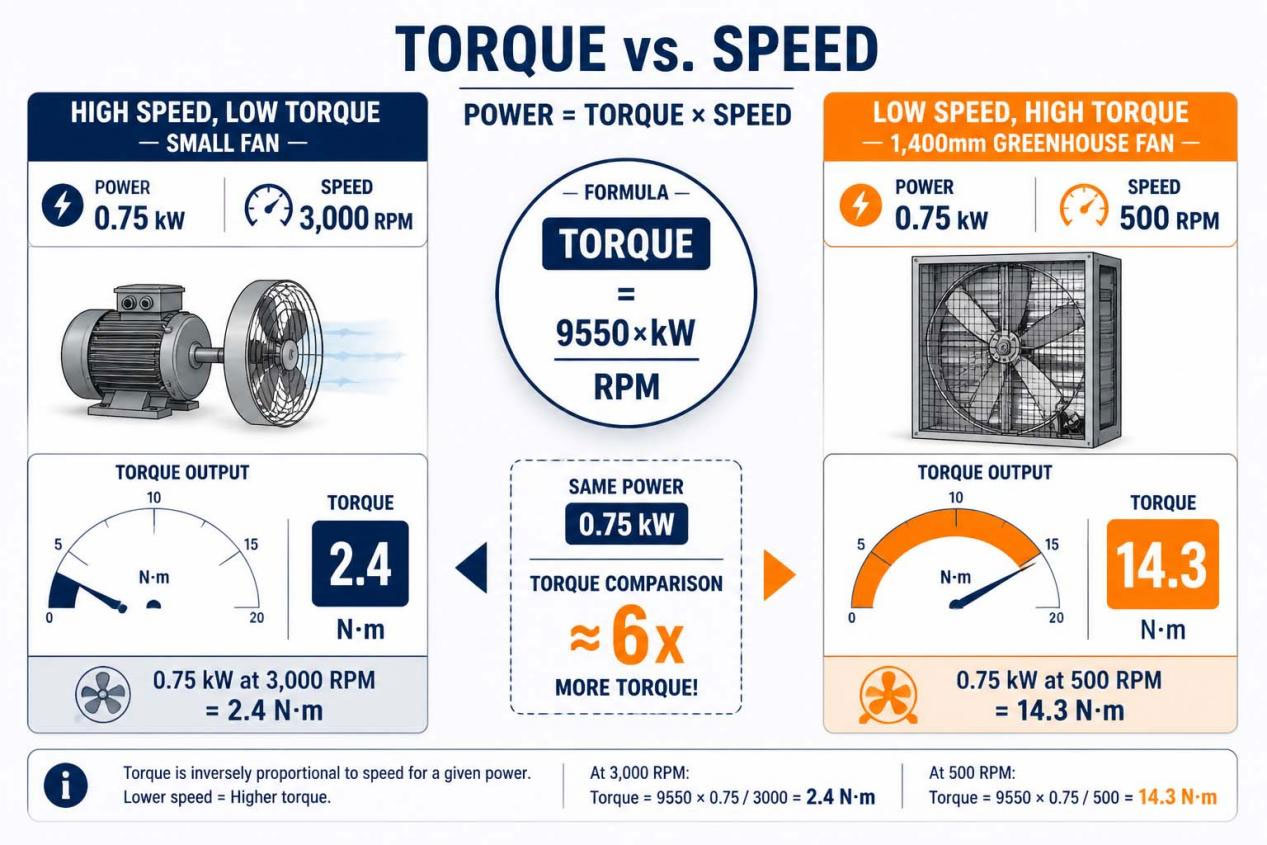
This is where most fan manufacturers and retrofit buyers make their first mistake. The motor that drives a 1,400mm fan at 500 RPM needs very different characteristics than a motor driving a smaller fan at higher speed. Power alone tells you almost nothing about whether the motor will turn the impeller.
The relationship is:
Крутящий момент (N·m) = 9550 × Power (кВт) ÷ Speed (Rpm)
А 0.75 kW motor at 3,000 RPM produces 2.4 N·m of torque. The same 0.75 kW motor at 500 RPM produces 14 N·m – nearly six times more torque. Large-diameter greenhouse fans operate at low speed and require high torque. Selecting by power alone often results in a motor that can’t start the fan under load.
The correct sequence: determine speed from impeller diameter → calculate required torque → select the motor → then compare power and price.
Why EC Motors Are Changing Greenhouse Fan Design
For decades, greenhouse fans relied on AC induction motors, often with belt drives or direct-drive configurations. Belt-driven fans have historically been preferred for efficiency, but they require maintenance – belt tensioning, replacement, and alignment.
ЕС (с электронной коммутацией) motors have changed the equation, and not just because they save energy.
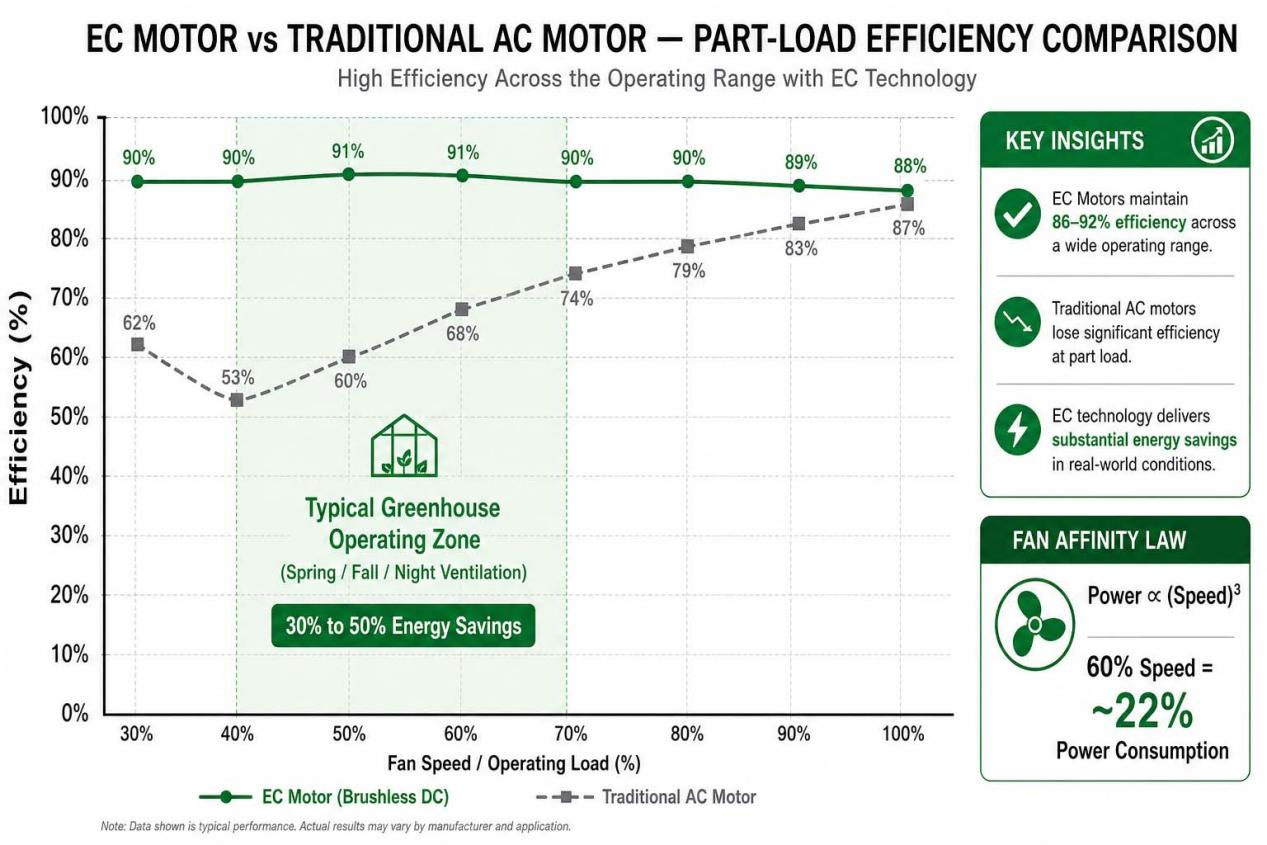
Part-load efficiency is where the real difference lives.
A greenhouse fan rarely runs at full speed year-round. Summer demands full airflow. Spring and fall require partial ventilation. Winter needs minimal air exchange to control humidity and CO₂.
Variable speed control enables demand-based ventilation.
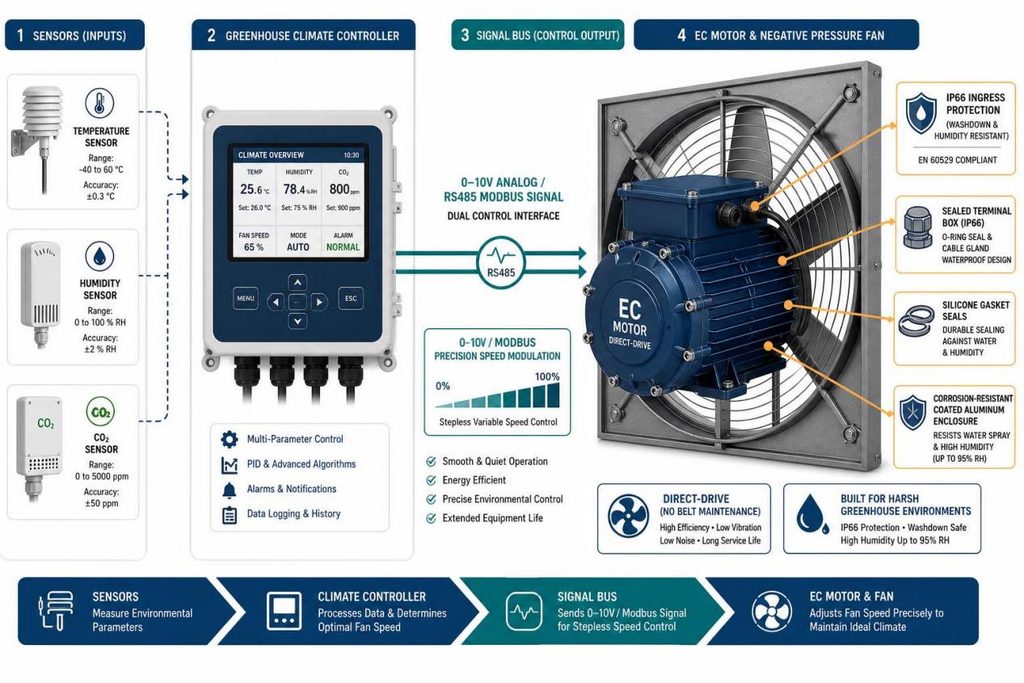
Instead of running fans at fixed high/low speeds or cycling them on and off, EC motors support continuous speed modulation via 0-10V analog or RS485/Modbus signals. The fan can respond directly to temperature, влажность, or CO₂ sensor readings from the greenhouse climate controller. According to the fan affinity laws, power scales with the cube of speed – reducing speed to 60% cuts power consumption to roughly 22% of full-speed power.
Low-speed, high-torque operation enables larger impellers.
Greenhouse fans benefit from large diameters because a larger impeller moves more air per watt of power. A 48-inch diameter fan with a half-horsepower motor can deliver the same airflow as a 36-inch fan with a 1 HP motor, while using significantly less energy.
But large impellers at low speed demand high torque. ЕС-двигатели – being permanent magnet synchronous designs – produce higher torque density than induction motors of comparable size at low speeds. This makes them well-suited for direct-drive configurations that eliminate belts and their associated maintenance.
For greenhouse applications, EC motors with IP55 or IP66 protection are increasingly common because greenhouses are humid environments. Condensation, irrigation spray, and periodic washdown can compromise motors with lower ingress protection ratings.
What Fan Manufacturers Should Look For in an EC Motor
If you build greenhouse negative pressure fans, the motor is a design decision, not a commodity purchase. Four parameters matter most:
1. Torque at the actual operating speed.
Don’t specify a motor by power. Specify by torque at the fan’s design RPM. For a 1,400mm fan operating at 500 Rpm, the required shaft torque is approximately 14 N·m. The motor must deliver that torque continuously, not just at peak.
2. Ingress protection matched to the greenhouse environment.
Greenhouses maintain 80-95% relative humidity. Motors installed near evaporative cooling pads or washdown areas should have IP66 protection. A rating of IP55 is the minimum for general greenhouse ventilation, but verify the motor’s protection against humid air over long periods, not just water spray.
3. Control interface compatibility.
The fan needs to integrate with the greenhouse climate controller. EC motors with 0-10V analog inputs and RS485/Modbus outputs allow the fan to operate as a controlled node rather than a standalone device. This enables the fan to modulate speed based on real-time conditions.
4. Thermal performance at minimum speed.
In spring and fall, greenhouse fans may run at very low speed for extended periods. EC motors generate less heat than AC motors, but confirm the motor’s temperature rise at minimum operating speed. A motor that runs cool at full speed may still overheat if the cooling path relies on airflow generated by the impeller.
What Fan Buyers Should Look For on a Spec Sheet
If you’re specifying a fan for a greenhouse project, the manufacturer’s catalog is the first filter. Three data points matter more than others:
1. Airflow at what static pressure?
A fan rated at “20,000 CFM” without a static pressure reference is not useful. Look for airflow at 0.10 inches of water static pressure, which is the industry standard for greenhouse fan selection. If the manufacturer only publishes zero-static airflow, ask for the rated data at 0.10 inches.
2. Ventilation Efficiency Ratio (VER).
The VER is the fan’s airflow output per watt of electrical input (CFM/Watt). A VER of 15 or higher is recommended for greenhouse applications. This metric captures the combined efficiency of the fan, мотор, and housing. A fan with a slightly higher purchase price but a higher VER often costs less to operate within two to three years.
3. Motor type and speed control capability.
Does the fan use an EC motor or an AC motor? Does it support 0-10V or Modbus speed control? If the fan only offers on/off or two-speed operation, precise climate control in a greenhouse is difficult. Continuous speed modulation is what allows the ventilation system to respond proportionally to sensor readings rather than cycling between too much and too little airflow.
A Realistic Look at Greenhouse Fan Energy Costs
Consider a 1-hectare greenhouse with a volume of approximately 30,000 m³. Summer ventilation target: 40 air changes per hour, requiring roughly 20,000 m³/h of airflow, or about 8-10 greenhouse fans of 1,400mm diameter.
If those fans use AC motors and run 4,000 часов в год (summer at full speed, spring and fall at reduced speed), annual fan electricity consumption is substantial. Replacing AC motors with EC motors in the same fan housings – keeping the impeller and structure unchanged – can reduce fan energy consumption by 30-50% depending on the operating profile. Fan manufacturers who can demonstrate this with a rated performance curve have a concrete advantage when bidding against competitors.
Итог
Greenhouse negative pressure fan performance depends on three things: расход воздуха, static pressure, and the motor’s ability to deliver torque at the required speed. The first two are fan design decisions. The third is a motor selection decision.
For fan manufacturers, specifying an EC motor by torque at operating speed – rather than by power – is the difference between a fan that starts reliably under load and one that trips on overcurrent. For growers and procurement teams, understanding the motor type and the rated static pressure conditions is the difference between a fan that performs as advertised and one that doesn’t.
We supply EC motors specifically for greenhouse ventilation fan applications – from 0.4 kW to 3.7 кВт, with low-speed high-torque characteristics, IP66 protection options, and 0-10V/RS485 control interfaces. If you’re developing or specifying a greenhouse fan system, we can provide torque-speed curves and matching recommendations for your impeller.
Contact us for a fan motor matching consultation: info@volcanomotors.com