 موتور آتشفشانی
موتور BLDC در مقابل سروو موتور: تفاوت ها, برنامه های کاربردی, و راهنمای انتخاب

مهندسان اغلب در توسعه تجهیزات با چالش های انتخاب موتور مواجه می شوند: تفاوت های کلیدی بین موتورهای BLDC و سروو موتورها چیست؟? چرا سروو موتورها گرانتر از موتورهای BLDC هستند؟? When is a servo motor required, and when can a BLDC motor serve the purpose perfectly?
Fundamentally, BLDC motors and servo motors are both permanent magnet synchronous motors, sharing similar structures and working principles. Their core difference rests on the control system. BLDC motors mostly adopt open-loop control with no position feedback or only basic Hall sensor feedback. Servo motors apply closed-loop control, fitted with high-resolution encoders to feed back real-time position, speed and torque data, and adopt PID algorithms for precise command execution to realize sub-micron positioning accuracy.
BLDC motors are ideal for cost-sensitive scenarios needing high efficiency, long service life and stable continuous rotation, such as fans, pumps and power tools. Servo motors are applied to fields that demand high-precision positioning, fast dynamic response and complex trajectory control, including robots, CNC machine tools and automated production lines.
1. Definition
1.1 What Is BLDC Motor

Brushless DC (BLDC) motors belong to high-performance synchronous electric motors. Different from traditional brushed DC motors, BLDC motors remove physical carbon brushes, greatly optimizing overall operating performance and service durability.
Major key characteristics of BLDC motors are listed below:
- Synchronous operation mode
- Electronic controlled commutation
- High energy efficiency and longer service life
- Optimized speed-torque performance
- Low noise and stable operation
- Compact and space-saving structure
With reliable operation and comprehensive functional advantages, BLDC motors are widely applied in automotive equipment, robotic systems, consumer electronics and many industrial fields. As a cost-effective and high-efficiency power solution, BLDC motors keep promoting the continuous upgrading and innovation of modern motor drive technology。
1.2 What Is Servo Motor
Servo motors are professional precision drive motors engineered to accurately control position, speed and acceleration. Widely adopted in industrial automation and robotics, servo motors stand out for their high precision and rapid dynamic response, which are essential for high-accuracy motion scenarios. They convert control signals into precise mechanical movements and support flexible, real-time motion adjustment for diverse industrial applications.
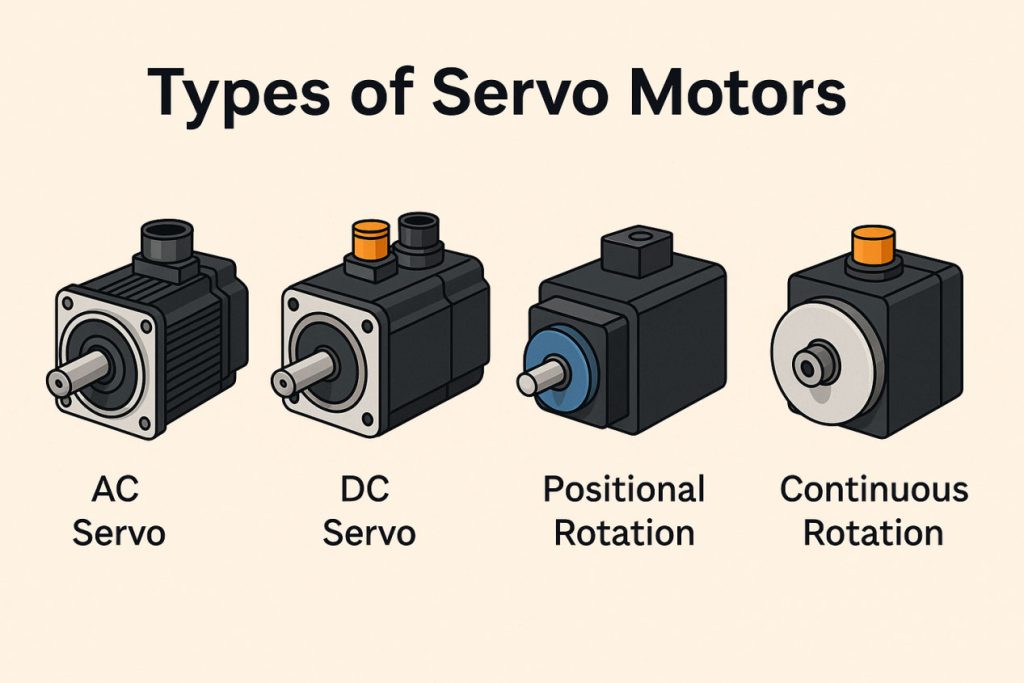
Key Characteristics of Servo Motors:
- Fast dynamic response
- High starting torque output
- Wide adjustable speed range
A complete servo motor system mainly consists of a motor body, high-precision feedback device and dedicated controller. The built-in feedback component continuously monitors real-time operating position and feeds data back to the controller, forming a closed-loop regulation system to guarantee accurate, stable and repeatable motion performance.
The following table outlines the primary types of servo motors and their applications:
| Type of Servo Motor | توضیحات |
| AC Servo Motors | Operate on alternating current, suitable for high-speed and heavy load applications. |
| DC Servo Motors | Simpler design, ideal for low-power applications like toys and small robotics. |
| Positional Rotation Servo Motors | Control angular movements, used in robotic arms and camera gimbals. |
| Continuous Rotation Servo Motors | Rotate freely in either direction, used in wheels and conveyor mechanisms. |
| Linear Servo Motors | Convert rotational motion to linear motion, used in actuators for industrial machinery. |
| Brushless Servo Motors | Use permanent magnets, offer higher efficiency and longer lifespan compared to brushed motors. |
Servo motors serve as the core component of servo systems, converting control signals into precise angular displacement and rotational speed. To deliver outstanding acceleration performance, servo motors are engineered with minimized rotor inertia, typically by limiting moving parts on the rotor to only electrical circuits. This optimized structural design greatly boosts overall operating efficiency and dynamic performance, making servo motors the ideal option for industrial scenarios that require high precision and long-term stable operation.
2. What Is the Difference Between BLDC Motors and Servo Motors
2.1 Feedback Mechanisms and Control Precision
Feedback mechanisms play a crucial role in the performance of both motor types. The table below highlights how they differ in this aspect:
| نوع موتور | Feedback Mechanism | Control Precision |
| Servo Motor | Requires a position feedback sensor | Can control position, سرعت, and acceleration at fine-angular points |
| موتور DC بدون جاروبک | Operates electronically without brushes | Offers high precision but typically lacks position feedback unless integrated with additional sensors |
2.2 Torque and Speed Ranges
Torque and speed capabilities are vital for determining the suitability of a motor for specific applications. The following table illustrates the typical ranges for both motor types:
| Feature | موتور BLDC | Servo Motor |
| محدوده سرعت | High speed capability with smooth movement. | Works great across a wide range of speeds. |
| گشتاور | High efficiency and torque at various speeds. | High torque across the full speed range. |
2.3 Response Time and Accuracy
Response time and accuracy are critical factors in motion control systems. The table below compares these features:
| Feature | موتورهای BLDC | Servo Motors |
| Response Time | Moderate dynamic responsiveness | High dynamic responsiveness |
| Positioning Accuracy | Moderate positioning accuracy | Exceptional repeatability and precision |
| Control Characteristics | Optimized for speed control | Engineered for precise positioning and rapid adjustments |
| Application Suitability | Continuous rotation applications | Applications requiring precise positioning and rapid adjustments |
- BLDC motors are optimized for speed control, offering moderate positioning accuracy and limited trajectory control.
- Servo motors excel in high dynamic responsiveness, allowing for rapid adjustments in speed, گشتاور, and position.
- Servo motors provide exceptional repeatability, crucial for applications like robotic pick-and-place systems and CNC machining.
2.4 Control Mechanisms
BLDC control systems mostly adopt speed closed-loop or current (گشتاور) closed-loop control. Simple BLDC drive systems can even operate in semi-open-loop mode with mere voltage regulation. Though BLDC motors rely on Hall effect sensors to detect rotor position for commutation, such sensors feature very low resolution, which prevents high-precision position control.
Servo control requires a high-precision, full closed-loop solution with superimposed position, speed and current loops. Equipped with high-resolution encoders, such as 23-bit absolute encoders, servo motors feed back real-time data of rotation angle, operating speed and current to the driver. The drive unit executes high-speed operational calculations and completes real-time deviation correction to ensure accurate motion control.
3. Practical Selection for Different Working Scenarios
3.1 What Are the Applications of BLDC موتورها?

BLDC motors find extensive use across various sectors due to their efficiency and reliability. Their applications span consumer electronics and automotive industries, where they enhance performance and functionality.
Common Applications in Consumer Electronics
In the consumer electronics sector, BLDC motors power a range of devices. They are commonly found in:
- Power tools such as drills and screwdrivers
- Drones for stable flight control
- Smart portable devices like electric toothbrushes and vacuum cleaners
These applications benefit from the motors’ compact design and high efficiency, making them ideal for devices that require reliable performance in limited spaces.
Industrial Applications (Fans & Pumps)
Beyond consumer and automotive fields, BLDC motors are also widely used in industrial ventilation and fluid transmission equipment, with remarkable advantages in energy saving and stability. Key applications include:
– Industrial fans and ventilation fans: Providing stable air supply, low noise operation, and energy-saving effects, suitable for factories, workshops, and commercial buildings.
– Water pumps: Including centrifugal pumps, submersible pumps, and pipeline pumps, used in water supply and drainage systems, agricultural irrigation, and industrial fluid transportation, with high efficiency and long service life.
Automotive Applications
The automotive industry also leverages BLDC motors for numerous applications. They are integral to:
- Electric vehicles (EVs) and hybrid electric vehicles (HEVs)
- Electric power steering systems
- Cooling fans and air conditioning compressors
- Fuel pumps and battery cooling fans
- Windshield wiper systems and seat/window adjusters
These motors provide the necessary torque and speed control, enhancing vehicle performance and energy efficiency.
3.2 What Are the Applications of Servo Motors?

Servo motors play a vital role in various industries, particularly in applications requiring precision and reliability. Their ability to provide accurate control over position, سرعت, and torque makes them indispensable in many scenarios.
The following table outlines some primary use cases for servo motors:
| Use Case | توضیحات |
| Precision Manufacturing | Servo motors drive robotic arms for assembling electronics and automobiles, ensuring high-speed, accurate movements |
| Autonomous Vehicles | Essential for steering and braking systems, providing real-time adjustments for safe navigation. |
| Medical Robotics | Used in surgical robots for precise instrument control, enhancing surgical outcomes and reducing risks. |
| Warehousing & Logistics | Powers automated guided vehicles for efficient navigation and item handling, optimizing storage and retrieval. |
| Consumer Robotics & Drones | Enables smooth movements in devices like robotic vacuum cleaners and drones, enhancing user experience. |
Servo motors enhance accuracy and repeatability in automated assembly lines. Their integrated design combines the motor, driver, encoder, and control electronics, streamlining operations and boosting performance efficiency.
- Advanced motion algorithms enable rapid real-time adjustments, ensuring robotic arms maintain high precision in dynamic automated environments.
- Servo motors are engineered for high-precision positioning and speed regulation—critical for accurate part assembly in industrial production lines.
- Dynamic speed adjustment maintains optimal production pace while ensuring accuracy, reducing assembly errors and improving yields.
Selecting the right motor requires careful consideration of technical parameters. Both BLDC and servo motors have unique advantages and limitations; understanding these helps engineers make informed, cost-effective decisions.
3.3 Key Parameters to Consider
When choosing between BLDC motors and servo motors, evaluate the following parameters:
| Parameter | موتورهای BLDC | Servo Motors |
| Positioning Accuracy | Good (open-loop) to Very Good (with encoder) | Excellent (±0.001° possible) |
| محدوده سرعت | Excellent (can maintain torque across wide speed range) | Very Good to Excellent |
| Torque Density | Very Good | Excellent (especially at peak torque) |
| پیچیدگی کنترل | Moderate | High |
| Cost | Lower | Higher |
| Maintenance | Minimal | Minimal but more components to potentially fail |
Choose BLDC Motors When:
- Cost Sensitivity is High: BLDC motors generally cost 30-50% less than comparable servo systems.
- Continuous Operation is Required: BLDCs excel in applications needing constant speed.
- Space is Limited: Simpler control systems allow for more compact implementation.
- Precise Positioning isn’t Critical: Suitable for applications where approximate positioning suffices.
- Applications Include: Fans, پمپ ها, کمپرسورها, simple conveyor systems, and general automation where position feedback isn’t critical.
Choose Servo Motors When:
- Precise Positioning is Essential: Ideal for applications requiring exact positioning.
- Dynamic Response is Critical: Necessary when rapid acceleration and deceleration cycles are needed.
- Varying Load Conditions Exist: Servos adapt better to changing torque requirements.
- Complex Motion Profiles are Required: Suitable for multi-axis coordination or complex movement paths.
- Applications Include: CNC machines, robotics, pick-and-place equipment, packaging machinery, and precision assembly systems.
In summary, BLDC motors and servo motors serve distinct purposes across various applications. BLDC motors excel in energy efficiency and continuous operation, making them ideal for consumer electronics and automotive applications. برعکس, servo motors deliver high precision and rapid response, suitable for robotics and automation tasks requiring exact control.
سوالات متداول
Q: When should I choose a servo motor over a BLDC motor?
الف: Choose a servo motor when precision and rapid response are critical. Servo motors excel in applications requiring accurate positioning and dynamic load handling, such as robotics and CNC machinery.
Q: Can BLDC motors be used in high-speed applications?
الف: بله, BLDC motors perform well in high-speed applications. Their design allows for smooth operation at elevated speeds, making them ideal for tasks like fans, پمپ ها, and electric vehicles.
Q: Are servo motors more expensive than BLDC motors?
الف: Generally, servo motors have a higher initial cost due to their complex systems and components. با این حال, their precision and efficiency can lead to lower operational costs in the long run.
If you are unsure about motor selection for your project, our team specializes in customized BLDC motors and professional technical support. We deliver one-stop BLDC motor customization services to fit your specific application, budget and performance needs. For tailored solutions and inquiries, please contact us at info@volcanomotors.com.