 Volcano Motor
Guía de adquisición del sistema de ventilador AHU: Cómo elegir el sistema de ventilación adecuado para su edificio
Unidades de tratamiento de aire (UTA) son el corazón de la ventilación de edificios modernos. Acondicionan y hacen circular el aire., Mantener el confort interior y la calidad del aire.. Pero cuando se trata de adquisiciones, many buyers focus too narrowly on individual components — a fan here, a motor there — and miss the bigger picture.
The truth is, the fan section is where AHU performance is won or lost. The fan, el motor, the drive, and the controls have to work together as a system. And the best way to ensure they do is to procure the complete fan system from a supplier who understands how every piece fits.
This guide is written for facility engineers, HVAC contractors, and building owners who are planning to upgrade an existing ventilation system or specify a new AHU for a construction project. We’ll cover what an AHU fan system includes, how to evaluate performance, why EC fan motors have become the standard, and how to procure a complete fan system that delivers reliable, efficient performance for years.
We’ll also explain why we now offer complete AHU fan system procurement — with EC fan motors as the core component.
What Is an AHU System?
An air handling unit (AHU) is a central ventilation system that typically includes:
- Filters – remove dust, pollen, and contaminants from incoming air.
- Heating and cooling coils – condition the air to the desired temperature.
- Humidifiers or dehumidifiers – control moisture levels.
- Fan section – moves air through the ductwork to the building.
- Control system – regulates fan speed, temperatura, and airflow based on demand.
- Dampers and mixing boxes – control the ratio of outside and return air.
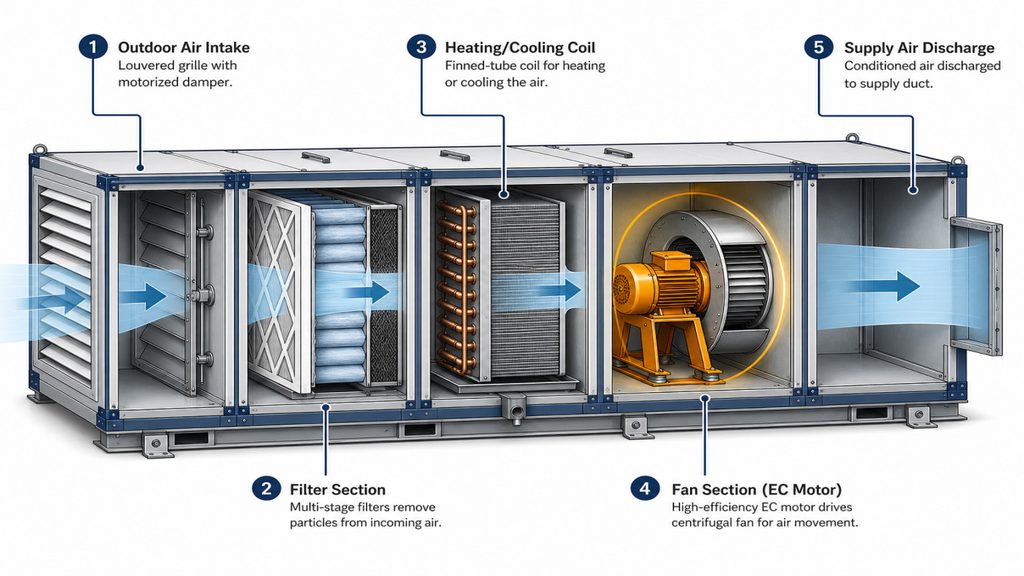
The fan section is the heart of the AHU. It typically consists of:
- Admirador – centrifugal, axial, or mixed-flow, selected for the required airflow and static pressure
- Motor – drives the fan, either directly or through a belt
- Drive – controls motor speed (integrated in EC motors, external VFD for AC motors)
- Controls – interface with the BMS to modulate airflow based on demand
- Mounting and isolation – springs, rubber isolators, and flexible connections to minimize vibration transfer
At Volcanomotor, we supply complete AHU fan systems — fan, motor CE, drive, controls, and mounting accessories — designed to work together from the start.
Why Procure the Complete Fan System?
When you buy fan components separately, you own the integration risk. If the fan doesn’t match the motor, or the controls don’t match the BMS, you’re the one who has to fix it. And when something goes wrong, you have multiple suppliers pointing fingers at each other.
Procuring a complete fan system from a single supplier solves these problems:
- Single point of responsibility – One supplier is accountable for the fan system’s performance.
- Optimized matching – The fan, motor, and controls are selected to work together from the start.
- Faster delivery – No waiting for separate shipments from different vendors.
- Lower total cost – Reduced engineering time, fewer integration issues, and better energy performance over the system’s life.
- Simplified maintenance – One supplier to call for spares, service, and support.
At Volcanomotor, we supply complete AHU fan systems — with EC fan motors as the core component. Whether you’re retrofitting an existing building or specifying for new construction, we can design, build, and deliver a fan system that meets your performance, eficiencia, and budget targets.
Key Factors in AHU Fan System Procurement
When evaluating an AHU fan system, here are the main parameters to consider:
1. Airflow and static pressure. Determine peak design airflow (CFM or m³/h) and total static pressure (in. w.g. or Pa). This defines the duty point for the fan and motor.
2. System type: CAV or VAV. Constant air volume (CAV) systems run at a fixed airflow. Variable air volume (VAV) systems modulate airflow based on demand — and can save significant energy when paired with variable-speed EC motors.
3. Turndown ratio. For VAV systems, what is the minimum airflow? This determines the minimum speed the fan motor must be able to hold. EC motors can typically operate down to 5–15% of rated RPM without stalling.
4. Energy efficiency. The fan section is the largest energy consumer in most AHUs. EC motors maintain high efficiency at partial load, unlike AC motors. Look for motors that meet IE4 or IE5 efficiency standards.
5. Controls and BMS integration. The fan system control should communicate seamlessly with your building management system (BMS). Common protocols include Modbus RTU, BACnet MS/TP, and 0–10V analog.
6. Noise and vibration. AHUs located near occupied spaces need low noise and vibration. EC motors run quieter than AC motors, but the fan assembly must be balanced and isolated.
7. Physical constraints. Verify the fan system footprint, height, and weight fit your mechanical room. Check duct connections, service clearances, and access for maintenance.
8. Maintenance and spare parts. What is the expected service life? What spare parts are recommended? How quickly can replacement parts be delivered?
Why EC Fan Motors Are the Standard for Modern AHU Fan Systems
EC motors have become the default choice for AHU fan sections because they deliver performance that AC motors simply cannot match.
Efficiency at all loads. EC motors achieve 90–93% efficiency at rated load. More importantly, they maintain 85–93% efficiency across a wide speed range, even at 40–50% of full speed. Traditional AC motors drop to 50–60% efficiency at partial load — exactly where most AHUs operate.
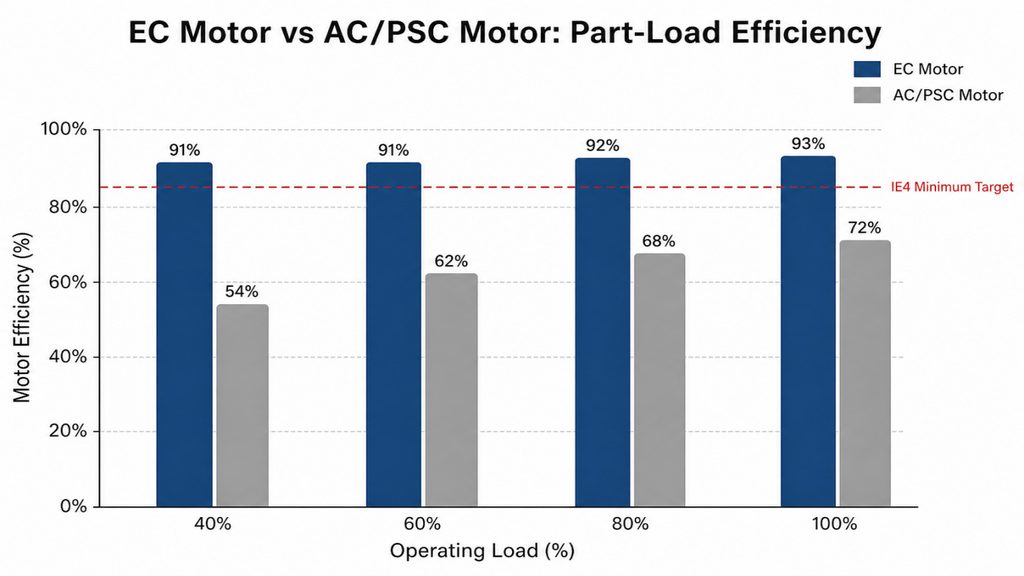
Variable speed control. EC motors have built-in variable-frequency drives. They can modulate speed smoothly from 5% a 100%, matching airflow to actual demand. This eliminates the energy waste of constant-speed operation with damper control.
BMS integration. EC motors support 0–10V analog, Modbus RTU, and BACnet MS/TP. They can report actual speed, power consumption, and fault status back to the BMS — enabling real-time monitoring and optimization.
Funcionamiento silencioso. EC motors run quieter than AC motors, especially at reduced speeds. For buildings where noise is a concern — schools, oficinas, healthcare facilities — this matters.
Solar compatibility. EC motors can run on DC power directly from solar panels, with grid backup filling the gap automatically. This enables on-site renewable generation without complex inverters or batteries.
Typical savings: Retrofitting an AHU fan section from AC to EC motors typically reduces fan energy consumption by 30–45%. For a 20,000 CFM AHU running 6,000 horas por año, that’s a savings of 20,000–28,000 kWh annually.
Sizing the Fan and Motor: The Five-Step Process
Correct sizing is critical. An undersized motor will fail; an oversized motor wastes energy at partial load. Follow this five-step process for any AHU fan system project.
Paso 1 — Define the duty point. Establish peak design airflow (CFM or m³/h), total static pressure, and system type (CAV or VAV). For VAV, define the minimum turndown ratio (typically 30–40% of design airflow).
Paso 2 — Plot the fan curve against the system curve. The system curve follows a parabolic relationship: pressure ∝ flow². The operating point is where the two curves intersect.
Calculate required brake horsepower:
BHP = (CFM × TSP) ÷ (6,356 × Fan Efficiency) — imperial
pag = (Q × Δp) ÷ (3600 × norte) — metric
Ejemplo: BHP = (10,000 × 2.0) ÷ (6,356 × 0.72) = 4.4 hp → select 5 hp motor
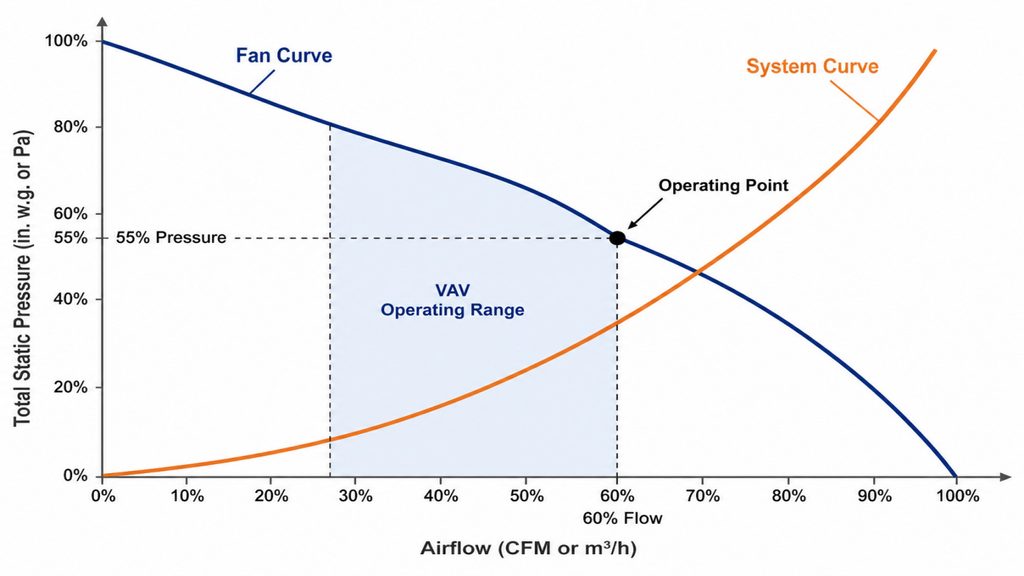
Paso 3 — Check partial-load efficiency. Review the motor’s efficiency map at 40%, 60%, y 80% of rated speed. For an EC motor, efficiency should remain above 88% across this range.
Paso 4 — Verify starting torque and minimum speed. EC motors produce 100–150% rated torque at zero speed. Confirm the minimum controllable speed (typically 5–15% of rated RPM) is below the VAV turndown setpoint.
Paso 5 — Confirm mechanical compatibility. Verify shaft diameter, flange pattern, and mounting dimensions. For 5,000–20,000 CFM direct-drive AHUs, a 5–15 hp (3.7–11 kW), 1,550–3,450 RPM EC motor is common.
Solar Integration with AHU Fan Systems
Pairing an AHU fan section with on-site solar is becoming standard practice in many regions. The key is to avoid unnecessary power conversions.
Direct DC-bus coupling allows solar panels to feed the EC motor’s internal drive bus directly through an MPPT (Maximum Power Point Tracking) converter. This eliminates one conversion stage, reducing losses from 8–12% (grid-tied inverter path) a under 4%.
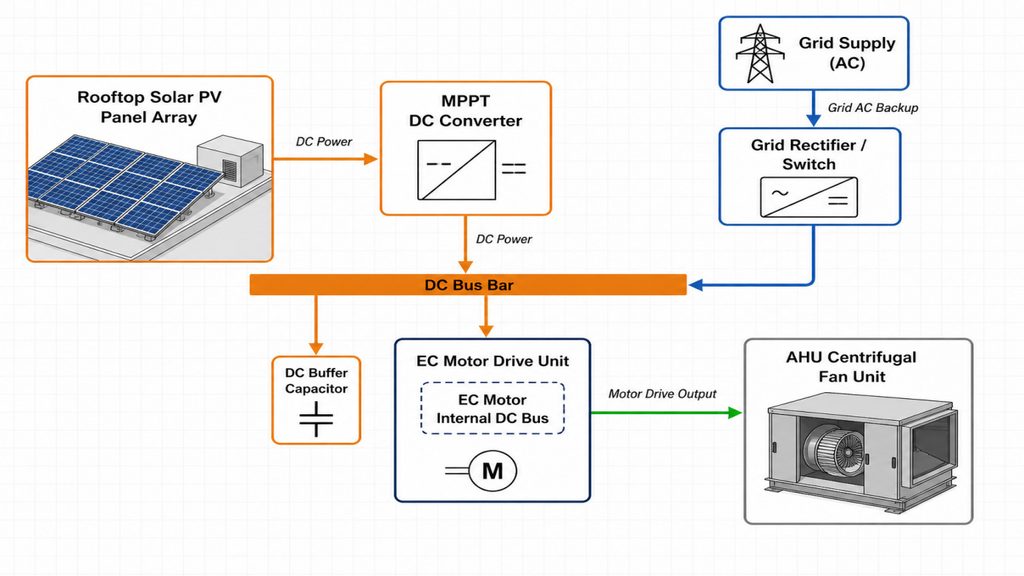
When solar output drops, the grid automatically fills the shortfall. No switching, no interruption. The fan keeps running at the same speed.
Key design considerations:
- Grid compliance: Local codes govern interconnection. Load-side DC coupling that feeds only the motor drive may qualify as an off-grid load, simplifying approval.
- Buffer capacitor: A small DC buffer or ultracapacitor smooths 10–30 second irradiance transients, maintaining comfort without battery storage.
- Demand charge reduction: Operating the AHU at reduced speed during peak solar hours can cut demand charges by 10–20%.
An integrated solar-AHU fan system with a 10–15 kWp array and a 7.5–15 hp EC motor is practical for mid-size commercial rooftops. Payback is typically 4–7 years under current incentives.
Maintenance and Troubleshooting
EC motors require less maintenance than AC motors — no brushes, sin condensadores, no belts. But periodic checks keep the fan system reliable.
| Interval | Task |
| Monthly | Inspect filters; check motor housing for dust |
| Quarterly | Verify control signal; check terminal torque |
| Semi-annually | Measure vibration; inspect drive vents |
| Annually | Full electrical inspection; bearing temperature check |
Common faults:
- Overspeed/hunting: Check for signal noise; add 100Ω termination; verify minimum speed parameter.
- Overtemperature: Check cabinet ambient; verify cooling airflow.
- Bearing noise: Replace bearing assembly if noise before L10 life.
- Modbus loss: Check 120Ω termination; verify baud rate and parity.
Complete AHU Fan Systems from Volcanomotor
We supply complete AHU fan systems — not just motors. Whether you’re upgrading an existing building or specifying for new construction, we can design, build, and deliver a complete fan system that meets your performance, eficiencia, and budget targets.
Proporcionamos:
- Free site energy assessment — We measure your current AHU fan power draw and calculate project-specific ROI within 48 horas.
- Fan curve + system curve matching — Submit your AHU nameplate data and we’ll confirm the correct fan, motor, and control interface.
- BMS mapping support — Modbus register maps and BACnet object lists delivered with every order.
- Utility rebate consulting — We identify applicable rebate programs in your region and provide documentation for your energy auditor.
Contact us for a no-obligation consultation: info@volcanomotors.com
Preguntas frecuentes
q1: What energy savings can I expect from an EC motor AHU fan system?
A1: Most commercial AHU retrofits achieve 30–45% fan energy reduction, with the highest savings in VAV systems operating at 40–70% load. A 10 hp PSC motor running 6,000 hours/year typically saves 20,000–28,000 kWh annually.
q2: How do I size the fan and motor for my AHU?
A2: Calculate required brake horsepower using BHP = (CFM × TSP) ÷ (6,356 × fan efficiency). Select the next standard motor size with a 10–15% margin. Verify efficiency at 40–80% speed and confirm minimum controllable speed is below the VAV turndown setpoint.
q3: Can I retrofit an existing AHU fan section with EC motors?
A3: In most cases, Sí. EC motors are available in standard NEMA and IEC frames, and often fit existing mounting points. The fan and housing can usually be reused. We can assess your existing AHU and recommend the best retrofit path.
q4: What maintenance do EC motors require?
A4: EC motors have no brushes or capacitors, so maintenance is minimal. Inspect filters monthly, verify control signals quarterly, and perform an annual electrical inspection. Bearings are sealed and typically last 40,000+ horas.
q5: Can AHU fan systems run on solar power?
A5: Sí. EC motors can run on DC power directly from solar panels, with grid backup filling the gap automatically. Direct DC-bus coupling reduces conversion losses to under 4%.