 موتور بركان
كيف تؤثر تهوية الحظيرة على إنتاج الحليب: الإجهاد الحراري, سرعة الهواء, وما الذي يعمل حقًا
قم بالدخول إلى أي حظيرة ألبان في فترة ما بعد الظهيرة الحارة من شهر يوليو, ويمكنك خلال ثلاثين ثانية معرفة ما إذا كانت التهوية تقوم بعملها أم لا. Cows will be standing instead of lying down. Respiration rates will be elevated. You might see them bunched together in a corner, trying to find a pocket of moving air.
Here’s the thing about heat stress in dairy cattle: the production loss doesn’t show up immediately. It accumulates. A cow that spends three consecutive days above her heat stress threshold will lose milk yield not just on those days, but for up to ten days afterward. The damage compounds, and by the time you see it in the bulk tank, you’ve already lost money you can’t recover.
But there’s a measurable, fixable variable that sits right at the center of this problem: air speed at the cow’s resting height.
What Happens Inside a Heat-Stressed Cow
Dairy cows have a thermal comfort zone between roughly 5°C and 25°C, with optimal conditions in the 4–20°C range. Above that, they start spending energy on cooling instead of milk production.
The cow’s first response is behavioral: she eats less, lies down less, and stands more. Standing exposes more body surface area to airflow. But it also means she’s not resting, and resting time is when milk synthesis happens.
Then the physiological response kicks in. Respiration rate climbs. Sweating increases. Core body temperature rises. A recent study tracking both lactating and dry cows found thatfor lactating cows, cooling measures should begin when THI reaches 66 ل 67 – well below the long-standing threshold of 72 that many farms still use as their trigger point.
For high-producing Holsteins, the picture is even tighter. Research consistently shows that high-yield cows begin losing milk at a THI threshold of68.5 ل 70 – and after that point, losses accelerate rapidly. In one study, as THI climbed from 68.36 ل 77.99, herd-level production dropped by 1.61%.
Table 1 THI thresholds and when to start cooling
| Indicator | Threshold / Range | Applies to |
| Cooling start point | THI 66–67 | Lactating cows |
| High-yield Holstein milk loss begins | THI 68.5–70 | High-producing cows |
| Traditional heat stress threshold | THI 72 | General reference |
| New Zealand breed thresholds | Holstein Friesian 68 / Kiwi Cross 69 | NZ herds |
| Accelerated yield drop range | THI 68.36 → 77.99 | Herd level |
The Variable You Can Actually Control
Heat stress depends on ambient temperature and humidity. You can’t change the weather. But you can change how effectively air moves across the cow’s body surface – and that’s where ventilation design becomes a production decision, not just a comfort one.
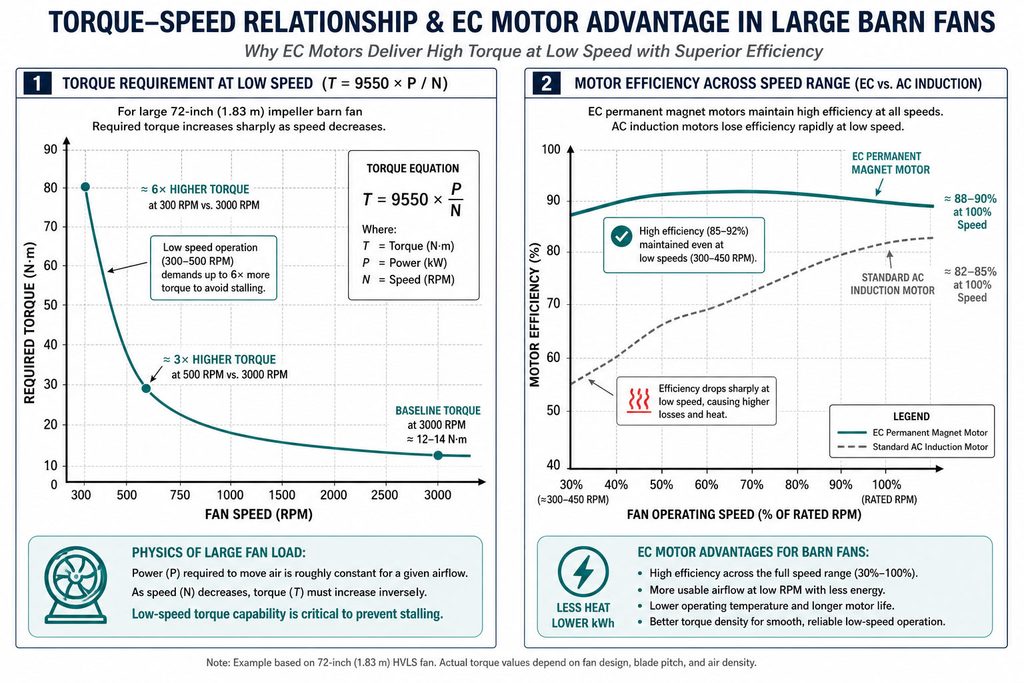
The science behind this is straightforward. When air moves across a cow’s skin, it accelerates convective heat loss. The faster the air, the more heat the cow can dump. Research from the University of Wisconsin-Madison’s Dairyland Initiative recommends achieving air speeds of 1–2 m/s over all cattle resting areas – stalls, pack areas, and holding pens.
The minimum effective air speed is generally accepted as 1 m/s (200 fpm) at the cow’s resting height, measured about 0.5 meters above the stall surface. But 1 m/s is the floor, not the goal. At higher THI levels, 2 m/s (400 fpm) is significantly more effective – and that’s where the production difference shows up.
Table 2 Target air speeds by application
| طلب | Target air speed | Measurement position |
| Resting stalls (minimum) | 1 m/s (200 fpm) | 0.5 m above stall surface |
| Resting stalls (high THI) | 2 m/s (400 fpm) | 0.5 m above stall surface |
| Holding pen | ~3 m/s | Cow body height |
| Calf barn tube outlet | ~0.3 m/s | 0.9–1.2 m above floor |
This is where it gets interesting.
When Air Speed Becomes a Milk Yield Metric
In the summer of 2021, British Columbia’s Fraser Valley experienced an unprecedented heat dome. Temperatures exceeded 40°C – 15 to 25°C above seasonal daytime maximums – and stayed there for days.
Eight dairy farms were monitored during this period. Researchers measured air speed at cow resting height in the free stalls and compared it against milk production data.
The results split the farms into two clearly distinct groups.
- Four farms had poor cooling: fewer than 20% of stalls achieved air speeds above 2 m/s at resting height. On these farms, production decreased on average by 7.49%.
- Four farms had effective cooling: أكثر من 50% of stalls achieved the 2 m/s target. On these farms, the average production decrease was 1.71%.
Same region. Same heat dome. Same weather conditions. The difference in milk yield between the two groups was 5.8 percentage points.
That gap is entirely attributable to one thing: whether the fans in those barns were actually moving air into the stalls where cows were lying down.
This is the single most important takeaway from the study, and it’s worth stating plainly: the investment return on ventilation is not determined by whether you installed fans. It’s determined by whether the air speed at the cow’s resting height meets the target. A barn full of fans that blow air over the cows’ backs instead of into the stalls is not a ventilation system. It’s a fan collection.
The Fraser Valley researchers noted that the practical fix was often simple – adjusting fan angles, removing obstructions, or adding fans in the right places.
But hitting that air speed target consistently is a motor problem, not just a fan problem. It comes down to motor torque at low speed – and that’s what we’ll look at next.
Why Low-Speed, High-Torque Operation Matters
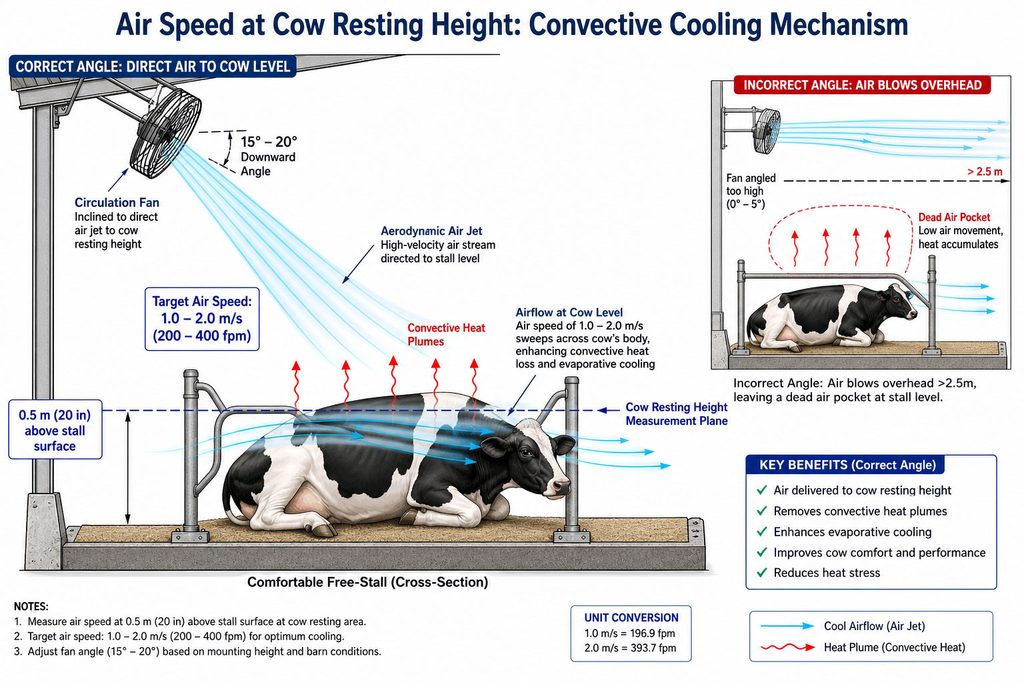
Large-diameter barn fans – typically 48 ل 72 inches – are designed to move a lot of air at relatively low rotational speeds. A 48-inch fan might run at 400–500 RPM. A 72-inch fan might operate at 300–400 RPM.
Here’s the problem: at those speeds, the motor needs to deliver substantial torque to turn the impeller. And torque isn’t something you can infer from the motor’s rated power.
The relationship is:
عزم الدوران (N·m) = 9550 × Power (كيلوواط) ÷ Speed (دورة في الدقيقة)
أ 0.75 kW motor running at 3,000 RPM produces 2.4 N·m of torque. The same 0.75 kW motor running at 500 RPM produces 14 N·m – nearly six times more. If you select a motor by power rating alone, you’ll often end up with one that can’t turn a large-diameter impeller at the speed the barn requires.
This is where EC motors – permanent magnet synchronous motors with integrated electronics – have a structural advantage. Their torque density is higher than induction motors of comparable size, which means they can deliver the torque required to turn a large impeller at low speed without being physically oversized.
And because EC motors maintain efficiency across a wide speed range – typically staying above 85% efficiency from 40% ل 100% of rated speed – you can achieve the 2 m/s target at the cow’s resting height without running the fan at full power when full power isn’t needed.
The Fraser Valley study showed that 2 m/s is the target for high-THI conditions. But it also showed that the incremental benefit from running fans at 100% versus 60% comes at a doubling of energy cost. The right approach is to size the fan and motor combination so that the target air speed can be achieved at a moderate, efficient operating point – not at maximum speed.
The Economics of Getting Air Speed Right
Let’s put the production numbers in perspective.
On the poor-cooling farms in the Fraser Valley study, production dropped 7.49%. On the well-cooled farms, 1.71%. The difference – 5.78 percentage points – is what’s at stake when air speed at the cow’s resting height is inadequate.
For a farm with 200 lactating cows producing 35 liters per day at a milk price of $0.45 per liter, the monthly production difference is roughly:
Table 3 Monthly production and revenue impact (200 cows, 35 L/day, $0.45/L)
| Item | Well-cooled group | Poorly cooled group | Difference |
| Production drop | 1.71% | 7.49% | 5.78 percentage points |
| Monthly production | ~206,400 L | ~194,300 L | ~12,100 L |
| Monthly revenue loss | – | – | ~$5,445 |
في $0.45 per liter, that’s $5,445 in lost revenue per month – during the heat stress season alone.
Against that number, the cost of ensuring proper air speed – the right fans, the right motors, the right control settings – looks like a rounding error.
What This Means for Your Barn
If you manage a dairy barn, here are the practical takeaways:
1. Measure air speed at cow resting height. Not at eye level, not at the fan outlet. في 0.5 meters above the stall surface, where the cow’s body actually is.
2. Target 2 m/s, not 1 m/s, for summer cooling. The minimum is 1 m/s, but at high THI, 2 m/s is where the production protection kicks in.
3. Check fan placement and angle first. Before you buy new equipment, check whether your existing fans are actually aimed at the stalls. Many are not. Adjusting angle costs nothing.
4. When you do upgrade, select motors by torque at operating speed – not by power rating. A motor that can’t turn the impeller at the design speed is not a motor that meets your ventilation requirement, regardless of what the nameplate says.
5. Consider variable-speed control. The ability to modulate fan speed based on THI – rather than running on/off or at fixed high speed – allows you to achieve the target air speed with the minimum energy input. EC motors with 0-10V or Modbus control interfaces make this straightforward.
Heat stress is not something you can prevent. But you can control how much it costs you. And the single most impactful variable you can measure and manage is the air speed at your cows’ resting height.
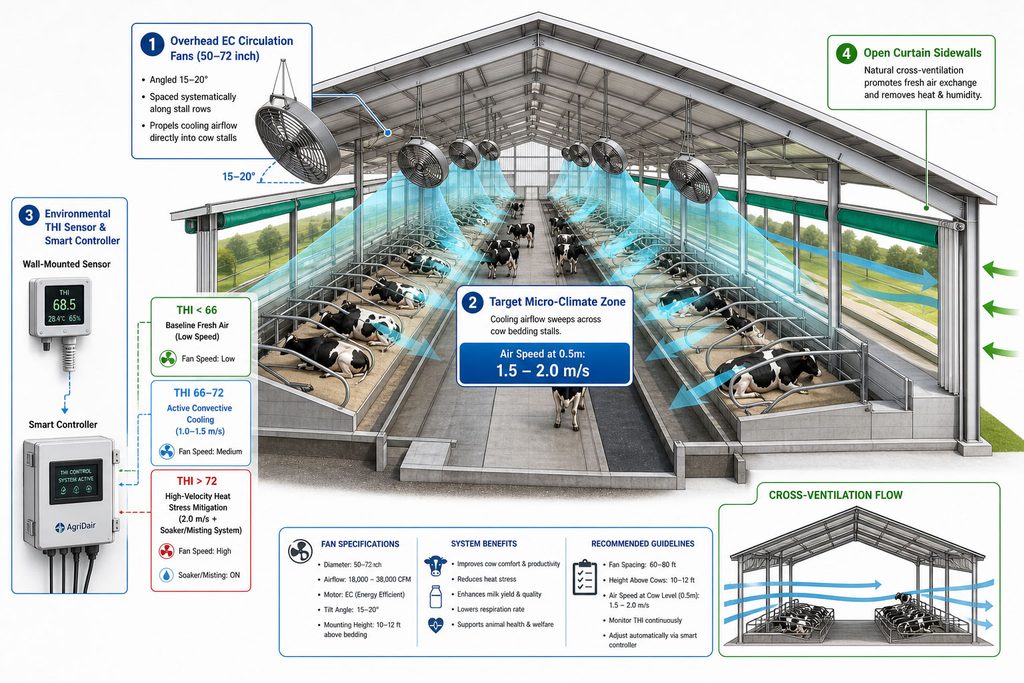
Need help measuring air speed in your barn or selecting the right fan motors for your ventilation system? We supply EC motors and EC Fans designed specifically for agricultural ventilation applications – عزم دوران عالي بسرعة منخفضة, variable speed control, and durability in harsh barn environments.
اتصل بنا: info@volcanomotors.com
التعليمات
س1: What is the minimum air speed I need at cow resting height?
أ1: At least 1 m/s (200 fpm) to reduce heat stress. But for high-THI conditions, target 2 m/s (400 fpm) for effective protection of milk yield.
س2: At what THI should I start cooling fans?
A2: For lactating cows, research recommends starting cooling measures at THI 66–67. High-producing Holsteins may benefit from cooling at THI 68.
س3: How much milk yield can I lose to heat stress?
A3: In the Fraser Valley study, farms with poor stall-level air speed lost 7.49% of production during a heat dome event. Farms with good air speed lost only 1.71%. Nationally, heat stress costs the U.S. dairy industry about $1.5 billion per year.
س 4: Why does motor torque matter for barn fans?
A4: Large barn fans run at low speed (300–500 RPM) and need high torque to turn the impeller. A motor selected by power rating alone may not deliver enough torque at that speed. EC motors have higher torque density than induction motors, making them better suited for direct-drive barn fan applications.