 موتور بركان
مراوح EC لحظائر الخنازير: يحفظ 50-75% على تكاليف طاقة التهوية
If you run a pig operation, you already know: ventilation isn’t a luxury, it’s essential. Pigs need fresh air, stable temperatures, and low ammonia levels. بدونها, they eat less, grow slower, and get sick more often.

The problem? Ventilation is one of the largest operating expenses after feed. In hog barns, it can account for about39% of total operating costs. Traditional AC fans run constantly, waste energy, and give you little control over airflow.
EC fans change that. Here’s what you need to know.
What Types of EC Fans Are Used in Pig Barns?
EC motors power virtually every fan type in a modern pig barn. The two main categories arewall-mounted axial fans (tunnel exhaust, the workhorses of summer cooling) و pit ventilation fans (under-floor exhaust for hydrogen sulfide and ammonia). EC motors also drive supply air fans (often paired with heat exchangers for winter ventilation), circulation fans (for destratification), و chimney/duct fans.
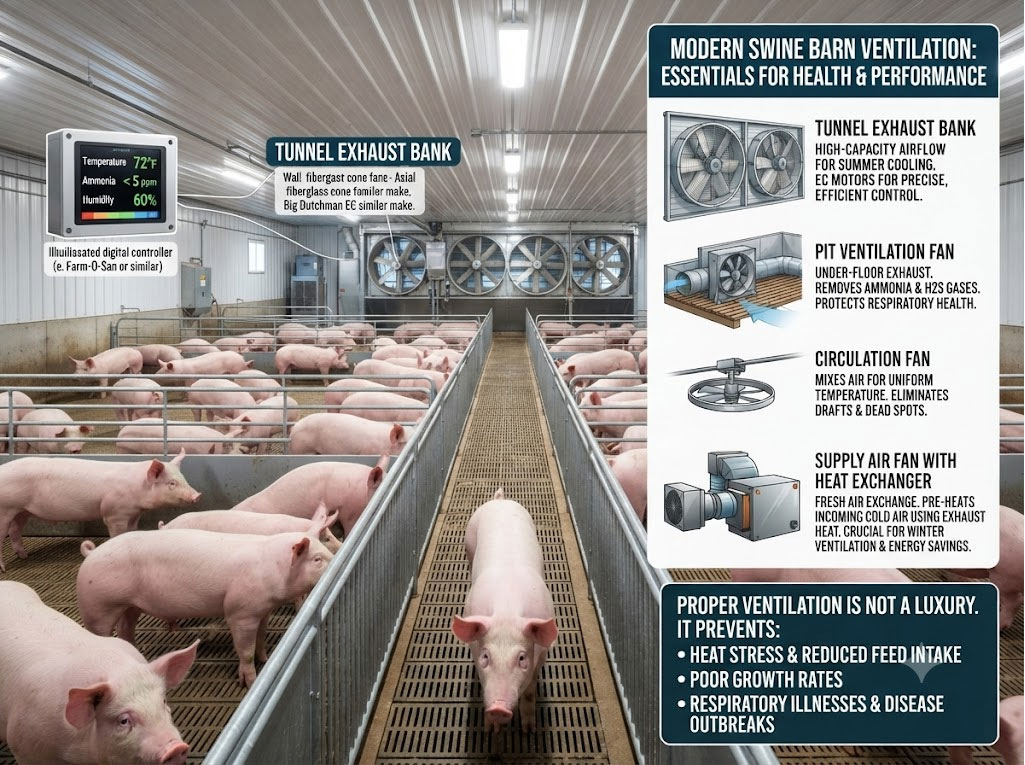
The common thread: all benefit from EC technology — higher efficiency, precise speed control, soft starting, and longer service life.
How EC Fans Improve Pig Health and Barn Air Quality
EC motors maintain high efficiency even at low speeds, which is critical for year-round ventilation. Their ability to modulate airflow ensures consistent temperatures, رطوبة, and air quality — reducing ammonia, heat stress, and respiratory disease. Different growth stages have different needs:
- Farrowing: low-speed, draft-free airflow without chilling piglets
- Nursery: precise temperature control without cold spots
- Finishing: ramp up during heat events, slow down at night
The health benefits are measurable: fewer respiratory issues, reduced stress, better feed conversion, and lower mortality. EC fans also run quieter – often below 50 ديسيبل – creating calmer barn environments.
Energy Savings and Total Cost of Ownership: The Financial Case for EC Fans
Ventilation electricity costs can hit 70% of overall operating costs. In swine barns, fans alone use at least 50% of total electricity. For a 3,000-sow operation, that can be 250,000 kWh/year.
Real–world case:A pig barn in Germany replaced 12 air-conditioning fans with centrifugal fans, utilizing existing openings.Forecast savings were 35%. Actual savings after six months: over 50%— more than 15,000 kWh/year, about €4,500 at €0.30/kWh.
Other verified data shows savings of40–70% in livestock ventilation.
A financial model for a 3,000–head finishing barn:
Current AC fan energy: ~30,000 kWh/year
With EC fans (50% savings): ~15,000 kWh/year
Annual saving at $0.12/kWh: ~$1,800
EC fan upgrade cost: ~$6,000-8,000
Simple payback: 3.3–4.4 years
In some regions, grants from the Ministry of Agriculture can cover 25% ل 50% of the costs for upgrading to energy-efficient ventilation systems, thereby further shortening the payback period.
EC vs. AC Fans: Why EC Technology Wins for Modern Pig Barns
| ميزة | AC Fan | EC Fan |
| Energy savings vs. standard | Baseline | 50-70% in hog barns |
| التحكم في السرعة | On/off or limited | Continuous, stepless |
| External VFD required | نعم | No(built-in) |
| Startup current | High surge | Soft start |
| Efficiency at low speed | Drops significantly | Maintains high efficiency |
| Maintenance | Belts, capacitors, more wear | Minimal(no brushes/capacitors) |
| مستوى الضوضاء | أعلى | Quieter(<50 ديسيبل) |
| Smart integration | Limited | Built-in(0-10V, مودبوس, sensors) |
The key differentiator: EC motors automatically adjust speed when airflow or pressure changes, maintaining target airflow at all times. AC motors draw 100% power regardless of required speed. In a pig barn where ventilation demand constantly fluctuates — day/night swings, seasonal changes, different growth stages — that continuous modulation translates directly into energy savings.
Practical Installation and Retrofitting Guidelines for Pig Barns
Positioning for different barn types:
- تهوية النفق (finishing): Fans at one end, inlets at the other. EC fans ramp up during heat events and slow down at night.
- Sidewall ventilation (farrowing/nursery): Fans along sidewalls. مشجعي المفوضية الأوروبية’ precise speed control prevents drafts.
- Curtain–sided barns: EC fans modulate airflow to match natural ventilation, reducing full mechanical ventilation needs.
Common mistake to avoid: Ignoring airflow balance. Adding EC fans without adjusting inlets creates dead zones or excessive pressure differences. Always check static pressure after installation.
Integration with existing controllers: EC fans work with 0-10V controllers, automation systems, and all common sensors – ثاني أكسيد الكربون, NH₃, درجة حرارة, رطوبة. Sensors detect barn conditions, the controller adjusts fan speeds in real time, and the barn stays optimal without manual intervention.
Solar DC Coupling EC Fans: The Ultimate Upgrade for Pig Barns
Once you’ve upgraded to EC fans, there’s another step that multiplies the savings: Solar DC couling energy system.
The problem with standard solar installs: Most solar systems use inverters to convert DC panel power to AC for the barn’s electrical panel. Then the EC fan’s built-in rectifier converts that AC back to DC for the motor. That’s two conversions — each wasting 3-5% of the energy.
العاصمة coupling solar system cuts out the middleman. EC fans have a DC input (the motor runs on DC internally). You run DC power directly from the solar panels to the fans, bypassing the inverter entirely. No DC-to-AC-to-DC conversion losses. The energy goes straight from the panel to the motor.
Why this is perfect for pig barn retrofits
- Minimal electrical work — Most EC fans have two separate power inputs: تكييف (grid) and DC (solar). Add a combiner box and a DC bus, no inverter needed. Existing AC wiring stays as backup.
- Solar–friendly speed profile — Peak solar hours (10am–4pm) align with the hottest part of the day, when ventilation demand is highest. When the sun is strong, the fans run hard on free energy.
- Seamless grid backup — When solar output drops (clouds, late afternoon), the system automatically draws the shortfall from the grid. No switching, no interruption, no manual intervention. The fans keep running at the same speed. This “blend” of solar and grid power happens continuously – using whatever solar is available and filling the gap with grid power.
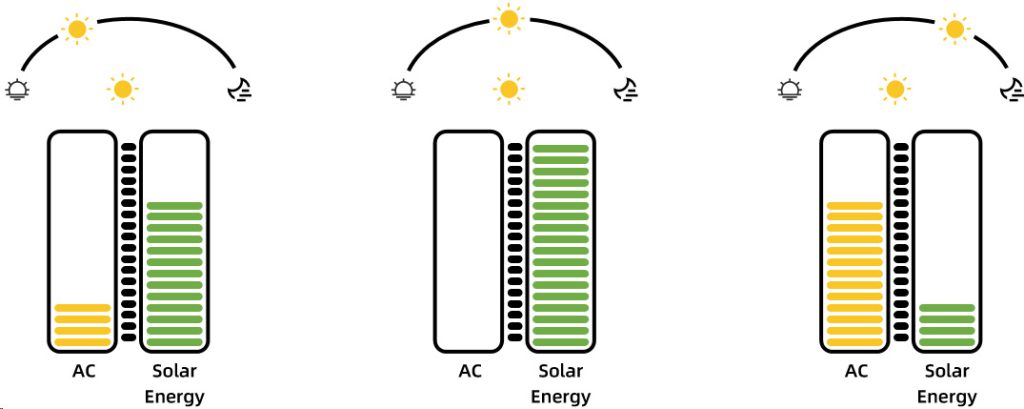
- No battery required — The grid acts as backup. Lower system cost, no battery maintenance.
- Works with existing EC fans — Most EC fan models already have a DC input port. Many accept a wide DC voltage range (على سبيل المثال, 48–380VDC), compatible with different solar array configurations.
What this means for your barn
| Scenario | AC fans + grid | مشجعي المفوضية الأوروبية + grid | مشجعي المفوضية الأوروبية + solar DC coupling system |
| Annual energy cost | $3,600 | $1,800 | $300–$500 |
| Equipment cost | — | +$6,000–8,000 | +$8,000–12,000 |
| Payback vs. baseline | — | 3.3–4.4 years | 2.5–3.5 years(including solar) |
A real-world example: A 3,000-head finishing barn with EC fans consuming 15,000 kWh/year. Add a 10kW DC-coupled solar array (about 25–30 panels) on the barn roof, generating about 14,000 kWh/year. أثناء النهار, fans run almost entirely on solar. When clouds reduce solar output, the system simply draws the difference from the grid – no switching, no interruption. Annual grid consumption drops from 15,000 kWh to under 4,000 كيلووات ساعة – a 75% reduction on top of the 50% reduction from the EC upgrade.
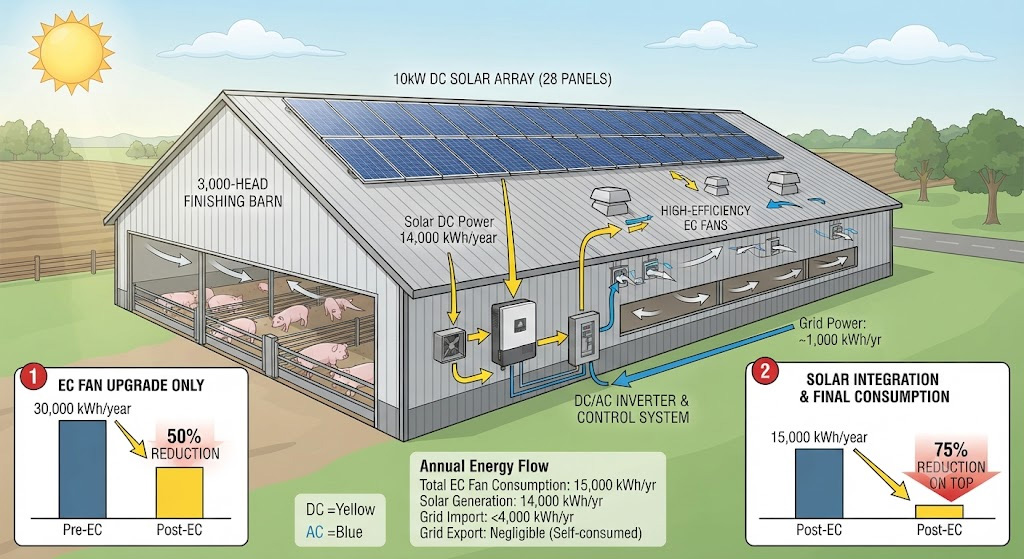
Retrofit-friendly: Panels on the roof, a combiner box, and a DC bus tying into the fans’ DC inputs. Existing AC wiring stays intact – if the solar system fails, fans revert to grid power. No single point of failure. No utility approvals for net metering (you’re using the power on-site). No export issues.
The bottom line on solar DC coupling ventilation system : It’s the most direct, lowest-loss way to get solar power into your barn ventilation system. Paired with EC fans, it cuts ventilation electricity costs to near zero during daylight hours – the time when fans work hardest. The seamless grid blend means you don’t worry about clouds or switching – the system just works.
The Bottom Line
Pig barns don’t have to accept high electricity bills as a fixed cost. EC fans cut energy consumption by 50-70%, provide precise airflow control, withstand corrosive barn environments, and require minimal maintenance. Paired with DC coupling solar system, savings multiply — cutting grid consumption by 75% on top of EC fan savings, with a combined payback of just 2.5–3.5 years.
If you’re tired of watching your electricity bill eat into your profits, EC fans with DC coupling solar system are the most straightforward fix I know.
Need help sizing EC fans for your pig barn?
We offer a comprehensive range of EC fans for livestock ventilation — wall‑mounted, pit, الدورة الدموية, and supply air configurations. In addition to supplying fans, we provide complete solar retrofit solutions that convert existing ventilation systems to DC coupling solar power, integrating directly with your fans and existing grid connection.
Contact us for a free assessment: info@volcanomotors.com
التعليمات
س: What improvements in pig health can I expect with EC fans?
أ: Lower ammonia, reduced humidity, fewer respiratory issues, and quieter barns – leading to better feed conversion and lower mortality.
س: How much energy can a U.S. pig barn save with EC fans?
أ: 50-70% compared to standard AC fans. For a 3,000-head finishing barn, roughly 15,000+ kWh/year.
س: What’s the main difference between EC and AC fans in swine facilities?
أ: EC fans provide continuous speed control, maintain high efficiency at low speeds, soft-start with reduced surge, and need minimal maintenance. AC fans draw full power regardless of demand.
س: Can EC fans help reduce ammonia and humidity in winter?
أ: نعم. Precise low-speed control allows continuous minimum ventilation without overcooling — removing moisture and ammonia while conserving heat.
س: What’s the difference between AC–coupled and DC–coupled solar?
أ: AC-coupled uses an inverter (DC-AC) then the fan rectifier (AC-DC) – two conversions, two losses. DC-coupled feeds DC directly from panels to the fan’s DC input – one conversion, less loss, simpler wiring, and seamless grid blending.