 Volcano Motor
Volcanomotor Troubleshoots and Commissions On‑Site for Pakistan Cooling Fan Customer
When you’re sourcing motors from overseas, the biggest question is always the same: “What happens if something goes wrong?”
We hear that from every customer. And honestly? It’s a fair concern. If a motor fails or doesn’t perform as expected, downtime costs money. And if the supplier is thousands of miles away, who’s going to fix it?
That’s exactly why we flew one of our engineers to Pakistan this June – to commission a batch of cooling fan motors and controllers for a customer, and to show them firsthand what our after-sales support actually looks like.
The Customer and the Project
Our customer runs a large air cooler company in Pakistan, and they purchased a batch of our brushless DC motors and matching controllers – a complete cooling fan drive system.
The motors themselves are solid. We test every unit before it leaves the factory. But the customer’s team had installed the motors and reported that several units weren’t running smoothly. They’d tried swapping controllers, checking wiring, and re‑terminating connections – but the problem.
They reached out to us with photos and videos of the problematic units. We could have walked them through troubleshooting remotely. We do that all the time. But this was a larger order, and the issues didn’t look like simple electrical faults. We needed to see the hardware in person. So we booked a flight.
Before We Left – Remote Diagnosis
Before boarding the flight, we spent time with the customer reviewing their installation process step by step. They’d followed the manual – mounting bolts torqued correctly, wiring verified, controllers set to the right parameters. Nothing obvious stood out.
But the pattern of problems told a story. The issues appeared on multiple units, and they were mechanical, not electrical. The motors were binding, running rough, or refusing to turn freely by hand – classic signs of rotor/stator misalignment, assembly errors, or bearing fit problems.
We prepared a troubleshooting checklist and confirmed the customer’s site had the tools and test equipment we’d need. We also set up a shared channel with our R&D team back home – if we ran into something unexpected, they’d be on standby to help remotely.
On Site – Troubleshooting and Finding the Root Causes
Upon arrival, we identified two major issues in the motor assembly.
Problem 1: Stator and Rotor Misalignment
The air gap wasn’t uniform – tight on one side, wide on the other. This creates unbalanced magnetic pull, causing drag and extra bearing load. We centered the stator using the air gap as a reference and re-torqued everything. The motor ran smoothly immediately.
Problem 2: Bearing Housing Tolerance Issues
The bearing seats in the end housings were off. Some too tight – bearings had to be forced, causing binding. Others slightly loose, allowing bearings to shift off-center. A few hundredths of a millimeter, and alignment goes out the window.
We selectively matched bearings to housings – tight bores got bearings from the lower tolerance range, loose ones from the upper – and got a proper fit on every unit.
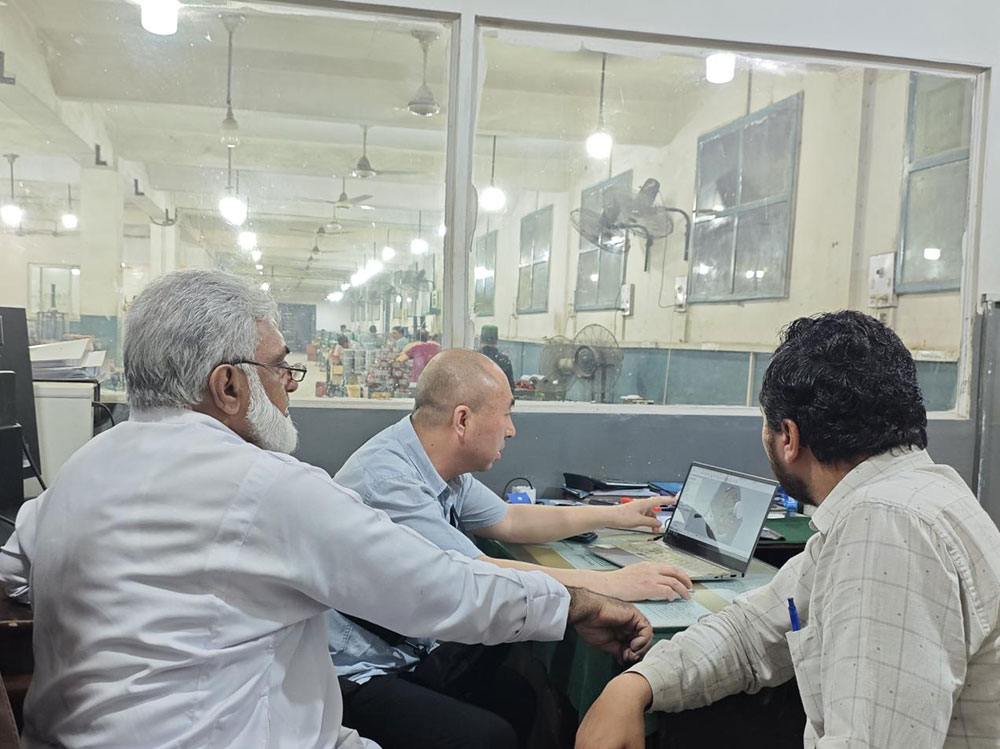
Commissioning and Final Verification
After resolving the mechanical issues, we:
- Ran each motor uncoupled for 30 minutes to verify smooth operation
- Optimized controller parameters for the specific fan load
- Tested motors coupled to fans at operating speed
- Trained the customer’s maintenance team on air gap checks, bearing fit measurement, and early warning signs
All test units passed commissioning and were handed over for full production use.
What This Trip Tells Our Customers
We flew engineers to Pakistan for two reasons:
First, because we take our products seriously. If a customer spends money on our motors, we want them to work – not just “good enough,” but exactly as specified. That means being willing to get our hands dirty when things don’t go perfectly.
Second, because we know remote support isn’t always enough. We do video calls, we share documents, we walk customers through troubleshooting steps over the phone. That works for 90% of issues. But when you’re dealing with complex installations, different electrical standards, or unfamiliar equipment, sometimes you just need a pair of eyes on the ground.
Our After-Sales Commitment
Remote technical support – Call, email, or video. We’ll guide your team through troubleshooting.
On-site commissioning – For larger orders, we send engineers to supervise installation and train your team.
Spare parts and documentation – Detailed records of every order for quick parts identification.
Continuous improvement – Field feedback refines our designs and quality processes.
Final Thoughts
Buying motors from overseas doesn’t have to mean taking a risk on support. We’re not a “ship it and forget it” supplier. We’re in this for the long haul – and that means being there when our customers need us, whether that’s through a video call or a plane ticket.
If you’re considering our motors for your cooling, ventilation, or industrial application and have questions about installation, commissioning, or support – reach out. We’d be happy to walk you through what to expect.
Contact us: info@volcaomotors.com