 Мотор вулкан
Как вентиляция вашего здания может сократить счета за электроэнергию?
Введение: The Energy Dilemma and Green Opportunity in Ventilation Systems
In modern buildings, вентиляционные системы выполняют функцию “невидимые легкие” которые поддерживают качество воздуха в помещении и здоровье. Однако, эти системы, which need to operate 24/7, with their numerous fans and constant energy consumption, are becoming a growing operational cost. Statistics show that in large commercial complexes or office buildings, ventilation systems can account for 15%-25% of the total building energy consumption.
Traditional energy-saving upgrades often stop at replacing standard fans with efficient EC fans. This only optimizes the “muscle” of breathing without changing its reliance on the “grid for blood.” This is where the integration ofsmart PV microgrid technology with advanced EC fans creates a paradigm shift, turning your ventilation from a passive cost center into an active, cost-saving asset.

ⅠThe Core of Ventilation Systems: Why Are EC Fans the Inevitable Choice?
Ventilation systems are widely used in various buildings, primarily consisting of:
- Distributed Axial Fans: Commonly used for ventilating individual rooms or zones. While single-unit power is low (typically under 100W), they are large in number and widely distributed, making their collective energy use significant.
- Centralized Centrifugal Fans: Used in core equipment rooms of malls and office towers, these are higher-power units responsible for supplying fresh air to entire buildings or large areas, representing the system’s primary energy-consuming components.

Regardless of type, their motors are rapidly evolving from traditional induction motors to permanent magnet synchronous EC motors. EC fans have become the preferred “heart upgrade” for ventilation systems due to these key advantages:
- Superior Energy Efficiency: Offering up to 30%-50% energy savings compared to traditional motors, directly reducing operational costs at the source.
- Precise Speed Control: Can adjust airflow from 0% к 100% based on signals from CO₂, PM2.5, or occupancy sensors, avoiding wasteful “idling.”
- Длительный срок службы & Низкие эксплуатационные расходы: Brushless design ensures reliable operation and significantly reduces maintenance costs.
Однако, simply upgrading to EC fans doesn’t address the root of energy supply. The system’s power still comes entirely from the grid, keeping its running costs tied to electricity price fluctuations and leaving it vulnerable to shutdowns during grid outages.
ⅡWhy Current “Green” Ventilation Solutions Fall Short
Existing market attempts to combine PV with fans often have significant flaws, hindering widespread adoption:
| Solution Type | Как это работает | Core Drawbacks |
| Off-Grid PV Fans | A standalone PV panel and battery system dedicated to a single fan, operating completely off-grid. | Prohibitively High Cost: Each fan requires a complete, independent PV-storage set-up, leading to enormous initial investment. Poor Flexibility: Energy cannot be shared; if one fan is off, its associated PV power is wasted. |
| Basic ACDC Coupling | Fans can use inverter-converted AC power from PV, with manual or simple switching between PV and grid power. | “One-to-One” Binding: One PV array typically only powers one fan, offering poor scalability. Crude Energy Management: Excess PV power cannot be utilized by other devices or intelligently stored. |
The essence of these solutions is applying an isolated product mindset to a systemic problem (energy supply for multi-node building ventilation), resulting in high costs and low efficiency.
Ⅲ The Smarter Integration: PV ПaraФlow Microgrid Technology for Ventilation Systems
We propose a disruptive third way: the PV Microgrid Ventilation Solution based on PARAFLOW energy routing technology and SolarChasing intelligent tracking algorithms. This is not just an add-on of components but a reconstruction of the system architecture.
1. The Game-Changer: “One-to-Many” Energy Sharing
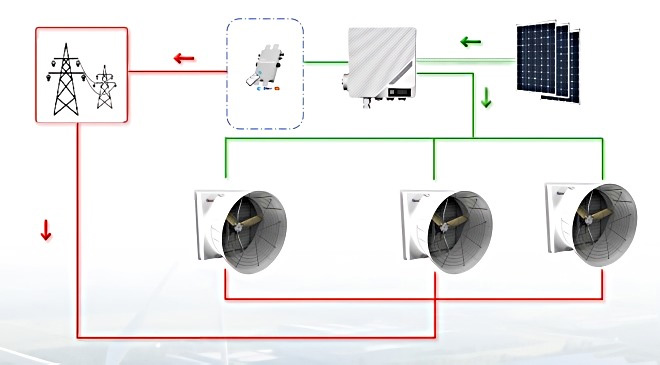
This is the fundamental difference between our technology and all other solutions on the market. We use an Energy Manager (Energizer) to create an independent DC microgrid within the building.
- One PV Array, Powers the Entire Network: A single, centralized PV array on the building’s roof feeds green power into the microgrid, intelligently shared by all EC ventilation fans connected to this network within the building.
- Intelligent Energy Routing (PARAFLOW): The microgrid acts as a “smart manager,” sensing in real-time which fans need to run and at what power, then accurately and dynamically allocates PV power to where it’s needed most. When one fan is off, its share of PV power is instantly redirected to other operating fans, achieving “zero waste” of solar energy.
2. Operation: 4 Modes for All Scenarios
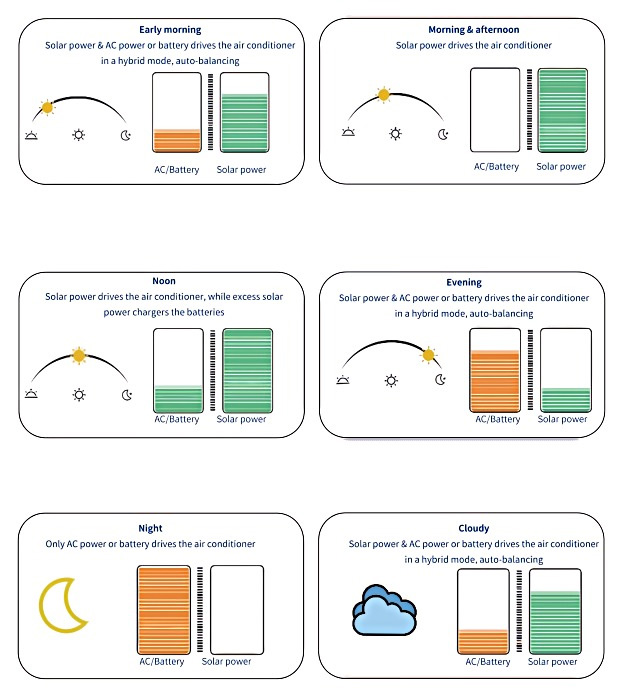
An EC ventilation system equipped with our technology can seamlessly switch between four energy modes:
- Pure PV Direct-Drive Mode: During sunny days, ventilation fans run entirely on free solar energy, achieving “zero electricity cost” вентиляция.
- ACDC Real-Time Coupling Mode: When PV power is insufficient (например, cloudy/rainy weather), the system automatically and imperceptibly draws precise supplemental power from the grid, ensuring fans operate steadily at the set power without any fluctuation in indoor airflow.
- Microgrid Energy Storage Mode: Excess daytime PV power automatically charges a central battery bank, which then powers the ventilation system at night, during peak tariff periods, or during grid outages, ensuring 24/7 uninterrupted building ventilation.
- Pure Grid Mode: Serves as a backup, guaranteeing basic system functionality under any circumstances.
Weather and sunlight conditions are constantly changing. It is entirely possible for all four modes to activate within a single day. As illustrated in the figure below, you can clearly see how the power supply status of the ventilation system varies throughout the day in response to changing sunlight levels.
3. Key Advantages: Tangible Value for Buyers and Owners
- Ultimate Cost-Effectiveness: Eliminates the redundant “one-fan-one-PV” configuration. Using one centralized PV array to meet the needs of multiple fans significantly reduces the per-fan cost of adding PV capability. The fans themselves are wired like standard EC fans, with an added microgrid interface for easy future upgrades.
- Intelligent Energy Saving: By prioritizing the use of PV-generated green electricity and optimizing the dispatch of distributed energy within the building, it significantly reduces the overall carbon footprint, aiding in achieving green building certifications like LEED or BREEAM.
- Proactive Safety & Zero Policy Risk: The system features a “передний гибрид, серверная часть вне сети” дизайн. PV power is solely consumed within the internal microgrid, physically preventing any back-feed to the public grid. This completely avoids complex grid interconnection approvals and utility certifications, complying with increasingly strict global distributed energy policies.
- Robust Assurance from Core Manufacturing in China: As China’s manufacturer with the most comprehensive range of both internal and external rotor EC fan series, we can provide the optimally matched core motor for different ventilation equipment needs (whether compact external rotor fans or high-static-pressure internal rotor centrifugal fans).
Ⅳ Application Scenarios: Who Benefits the Most?
- High Electricity Cost Regions: Europe, Япония, Австралия, и т. д., where rising tariffs make the project’s payback period particularly attractive.
- Areas with Unstable Grids: Юго-Восточная Азия, Ближний Восток, Африка, и т. д., where the system ensures continuous core ventilation during frequent outages, safeguarding basic building operation and safety.
- Green Buildings Pursuing High Standards: This system is ideal for developers and owners committed to creating net-zero energy or healthy buildings.
Заключение: From Cost Center to Value Creator
Transforming ventilation systems from passive energy-consuming devices into active “energy coordinators” и “low-carbon contributors” within a building is the fundamental change enabled by Eternal’s PV Microgrid EC Fan technology.
We offer not a single product, but a complete ecosystem: from the efficient heart (self-developed EC motors), to the intelligent circulatory system (PARAFLOW microgrid), and the green lifeblood (PV energy).
Contact us today for a customized energy-saving analysis and proposal for your project’s ventilation system, and take the key step toward creating the next generation of “green buildings that breathe intelligently.”