 Vulcão motor
Como dimensionar e selecionar um motor BLDC de alta eficiência para bombas de água
You’ve got a pump to spec—irrigation, circulação, ou um submersível de poço profundo. A questão é: qual motor realmente pertence à outra extremidade desse eixo?
I’ve seen otherwise well-designed pump systems fail because someone grabbed a standard AC motor off the shelf without running the numbers. Overcurrent trips. Flows that don’t meet spec. Motors that cook themselves in six months. None of it is mysterious—it’s just detail work that nobody wrote down in one place.
This guide covers why BLDC motors are replacing AC induction motors in pump applications, how to size them properly, and what the switch actually costs. No fluff, just what you need to put a BLDC motor on a pump and have it stay there.
Why BLDC Motors Are Taking Over Pump Applications
Where the Savings Come From
Energy-efficient motor design. A BLDC motor uses permanent magnets in the rotor instead of inducing current like an AC motor. No rotor copper loss, no slip, sem desperdício de energia. The result: IE5-equivalent efficiency—the highest efficiency class available today.
Wide high-efficiency operating range. An AC induction motor only runs at peak efficiency in a narrow band—typically 75% para 100% of rated load. Drop below that, and efficiency falls off a cliff. A BLDC motor stays efficient across 25% para 125% of rated load, which matters because pumps rarely run at full capacity all the time.
Variable speed, variable savings. Pumps spend a lot of time at partial load. With a BLDC motor and a smart controller, you match pump output to actual demand instead of wasting energy through throttling valves or bypass loops. The controller uses sensor feedback—pressure, flow, or temperature—to adjust speed in real time. When demand drops, the motor slows down, and because pump power scales with the cube of speed, the energy savings are substantial.
Real-World Energy Savings Data
- A submersible pump with a permanent magnet motor running 16 hours a day saves up to 9,100 kWh per year compared to a standard asynchronous motor
- PM motors deliver up to 21% energy savings compared to conventional induction motors
- Power factor improves to near unity (1.0), with reactive power savings as high as 40%
- ESP (electric submersible pump) run life increases from 2.5 years to 3.5 years—a full extra year of service
Sizing a BLDC Motor for Your Pump
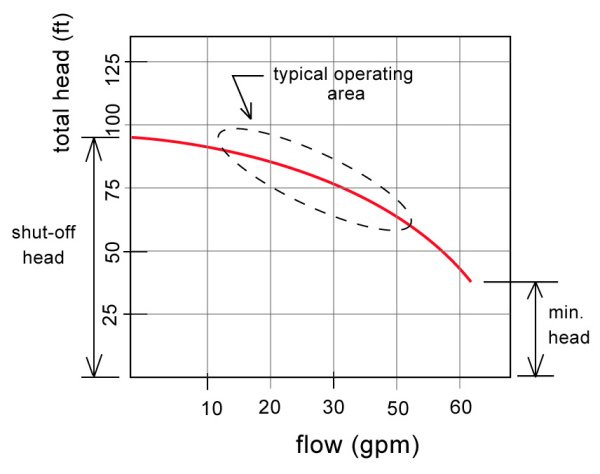
Start with the pump curve. That’s where the actual work happens. Skip this step and you’ll either undersize the motor (trips on overload) or oversize it (wastes energy and money).
Etapa 1 : Define your duty point
You need two numbers: required flow (P) in GPM or m³/h, and total dynamic head (H) in feet or meters. Head includes static lift, friction losses through pipes and fittings, and any pressure required at the discharge point. Don’t guess the friction losses—use a pipe friction calculator or the Hazen-Williams equation. Friction adds up fast in long runs.
Etapa 2 : Calculate hydraulic power
The shaft power the pump needs is:
Imperial: P = (Q × H) / (3960 × η) — in HP, using GPM and feet
Metric: P= (Q × H × 9.81) / (3600 × η) — in kW, using m³/h and meters
Pump efficiency (η_pump) typically runs 50–70% for small pumps, até 80% for larger ones. Get it from the pump curve—don’t assume 100%.
Etapa 3 : Add motor efficiency and a safety factor
Motor input power = P / η. BLDC motor efficiency is typically 85–92%. Add 10–15% margin for startups and temporary overloads.
Example – residential well pump: 10 GPM at 120 feet head. Pump efficiency around 55%. P_h = (10 × 120) / (3960 × 0.55) = 0.55 HP. Add motor efficiency (~85%) e 15% margin → about 0.75 HP. A 0.75–1 HP BLDC motor is the right fit.
Controller Selection: The Brain Behind the Motor
A BLDC motor is only as good as the drive running it. I’ve seen perfectly good motors fail because someone paired them with the wrong controller or ran unshielded sensor wires next to phase cables.
Sensored vs. Sensorless Commutation – Which One to Pick?
The table below breaks down the trade-offs.
| Recurso | Sem sensor (Back-EMF) | Sensorizado (Hall/Encoder) |
| Startup torque | Moderate – can struggle under heavy load | Excellent – full torque from zero speed |
| Low-speed performance | Limited – needs minimum speed for back-EMF | Excellent – smooth control at any speed |
| Wiring complexity | Simple – just 3 phase wires | Complex – 5 additional sensor wires |
| Confiabilidade | High – no sensors to fail | Moderate – sensors can fail in harsh environments |
| Custo | Mais baixo | Mais alto |
| Best for | Submersible pumps, clean water, constant speed | Dosing pumps, pressure boosting, velocidade variável |
Protection Features Your Drive Must Have
- Over-current protection
- Under-voltage protection
- Over-temperature protection
- Reverse polarity protection
- Dry-run protection (critical for well pumps)
Gabinete, IP Ratings, and Installation
The enclosure rating determines where the motor can go. Choose wrong and you’ll be replacing it in six months.
IP Rating Guide – What Each Rating Actually Means
| Classificação IP | Nível de proteção | Aplicações Típicas |
| IP54 | Dust-protected; splash-resistant from any direction | Indoor surface pumps in clean environments |
| IP55 | Dust-protected; protected against low-pressure water jets | Outdoor surface pumps with weather exposure |
| IP67 | Dust-tight; protected against temporary immersion (up to 1m for 30 min) | Minimum standard for submersible pumps |
| IP68 | Dust-tight; continuous immersion beyond 1m (depth specified by manufacturer) | Deep-well submersibles |
For submersible pumps, the motor must be fully sealed with potted connections and shaft seals rated for the operating depth. Standard mechanical seals (carbon/ceramic) work for most clean water applications; silicon carbide seals are better for abrasive or sandy water.
Retrofit Considerations
When replacing an AC motor with a BLDC, check:
- Frame size and mounting bolt pattern (NEMA or IEC)
- Shaft diameter and keyway dimensions
- Speed range—BLDC motors often run at different base speeds than AC motors, which shifts the pump curve
- Cooling—the new motor may have different cooling requirements than the old one
Installation Checklist
- Verify power supply matches motor voltage
- Check rotation direction (pumps are directional—running backward damages the impeller)
- Prime the pump before startup
- Run through a full speed range and verify flow/pressure at each step
Two Real-World Pump Applications
Aplicativo 1: Deep-Well Submersible Pump
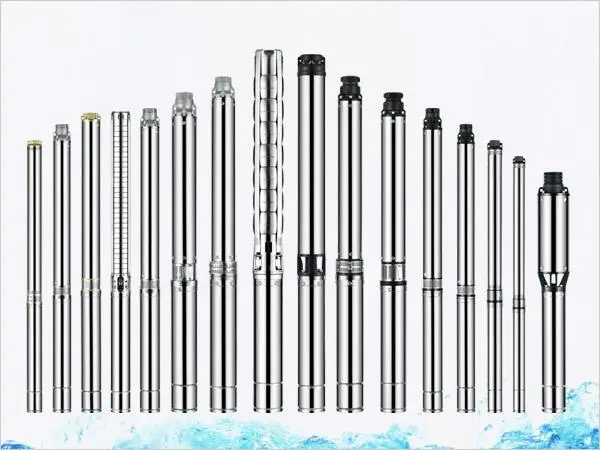
Challenge: A multi-stage deep-well pump operating from solar or battery power in a remote agricultural site. No grid power available. The pump needs high starting torque and must maintain efficiency across varying input voltages.
Solution: A BLDC motor with sensorless FOC control, IP68 rating, and an MPPT solar controller. The motor delivers high starting torque (critical for deep-well applications), maintains efficiency across a wide voltage range, and eliminates the brushes that would fail in a sealed submersible environment.
Key advantage: The BLDC motor runs at over 90% efficiency compared to roughly 70% for a comparable induction motor. In solar-powered applications, that efficiency difference is the difference between pumping water all day and running out of power by noon.
Aplicativo 2: Variable-Speed Circulation Pump
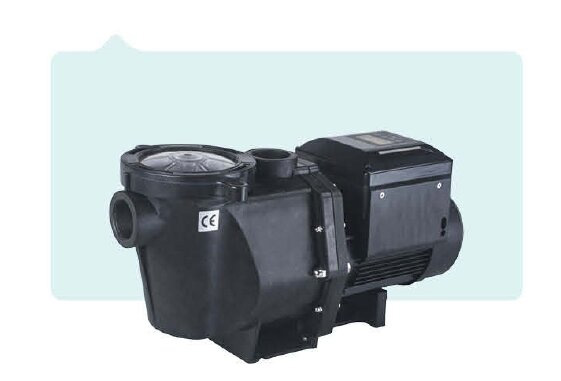
Challenge: A commercial building HVAC circulation pump that needs to match flow to variable cooling demand. Traditional fixed-speed pumps waste energy running at full speed regardless of demand.
Solution: A BLDC pump system with an integrated controller, sensor de pressão, and closed-loop PID control. The controller reads the system pressure, compares it to the setpoint, and adjusts motor speed in real time. When demand drops, the motor slows down—and because pump power scales with speed³, the energy savings are dramatic.
Key advantage: The system achieves constant pressure without the energy waste of throttling valves or bypass loops. Multiple pumps can be connected on a bus, allowing one controller to manage several pumps in parallel—if one pump can’t maintain pressure, additional units start automatically.
Does It Pay Off? ROI and Payback
The upfront cost of a BLDC pump motor is higher than an AC induction motor—typically 20–40% more. But the payback is fast.
- Até 14% energy savings compared to traditional induction motors
- Payback of 1 para 2 years in typical duty-rate systems
- Run life increases from 2.5 years to 3.5 years—an extra year of service
- Reactive power savings as high as 40% from near-unity power factor
Example – residential well pump retrofit: UM 1 HP AC submersible pump running 4 hours/day at $0.15/kWh costs about $165/year. Replacing it with a 0.75 HP BLDC pump cuts consumption by 30–40%—saving $50–$65/year. The BLDC pump costs $200–$300 more upfront, payback in 3–5 years. After that, it’s pure savings.
For continuous-duty applications, payback is even faster. Motors with 94% efficiency can provide payback in less than two years in long or continuous duty applications.
Still Not Sure Which Motor Fits?
Choosing a BLDC pump motor isn’t complicated—work through the numbers, match the pump curve, pick the right drive and enclosure, and the system will run efficiently for years.
We supply BLDC motors for residential, agricultural, and commercial pump applications. If you have a project in mind, send us your pump curve and site conditions and we’ll recommend the right motor and drive combination.
Contact us for a free pump match: info@volcaomotors.com
Perguntas frequentes
1º trimestre: What mechanical checks are most critical when retrofitting a BLDC motor onto an existing pump?
A1: Shaft diameter and keyway dimensions are the first things to check — they have to match the pump coupling. Also verify the frame size and bolt pattern (NEMA or IEC). Since BLDC motors often have different base speeds than the AC motors they replace, double-check that the new speed range still puts your pump’s best efficiency point within the operating window.
2º trimestre: How does the part-load efficiency of a BLDC motor compare to an AC motor in real pump duty cycles?
A2: This is where BLDC really pulls ahead. An AC induction motor’s efficiency drops sharply below 80% carregar, but a BLDC motor stays relatively flat across a wide range. In variable-speed pump applications that spend a lot of time at partial load, that difference can be 10–20 percentage points, which translates directly into energy savings.
3º trimestre: The motor runs but the pump isn’t delivering the expected flow — what should I check first?
A3: Start with the obvious: rotation direction. Pumps are directional — running backward will move water but at drastically reduced flow and pressure, and it can damage the impeller. If direction is correct, check whether the motor is actually reaching the target speed (verify with a tachometer) and that the pump isn’t air-locked or cavitating.
4º trimestre: What’s the most common failure mode in a BLDC pump motor, and how do I prevent it?
A4: Shaft seal failure is the most common cause of pump failure — water gets past the seal and into the motor, shorting the windings. For submersible applications, make sure the motor is rated for continuous immersion (IP68) and that seals are appropriate for the water quality (silicon carbide for abrasive or sandy water). Also, never run a submersible motor out of water for more than a few minutes — it relies on the surrounding water for cooling.