 موتور آتشفشانی
فن های EC برای تهویه مرغداری - راهنمای عملی
قبلاً می دانید تهویه ستون فقرات پرورش طیور است. پرندگان به هوای تازه نیاز دارند, دمای پایدار, و آمونیاک کم. بدون آن, مرگ و میر بالا می رود, تبدیل خوراک آسیب می بیند, and your electricity bill goes through the roof.
EC fans (electronically commutated fans) are not new, but most farms still run old AC or belt-drive fans. That’s a mistake. Let’s walk through what EC fans actually do for poultry houses, how to size them, and why they save you money.
What EC Fan Technology Means for Poultry House Ventilation
First, let’s clear up the term. EC stands for electronically commutated. In plain English: it’s a high-efficiency BLDC motor built into a fan, with onboard electronics that control speed smoothly. No belts, no capacitors, no wasted energy.
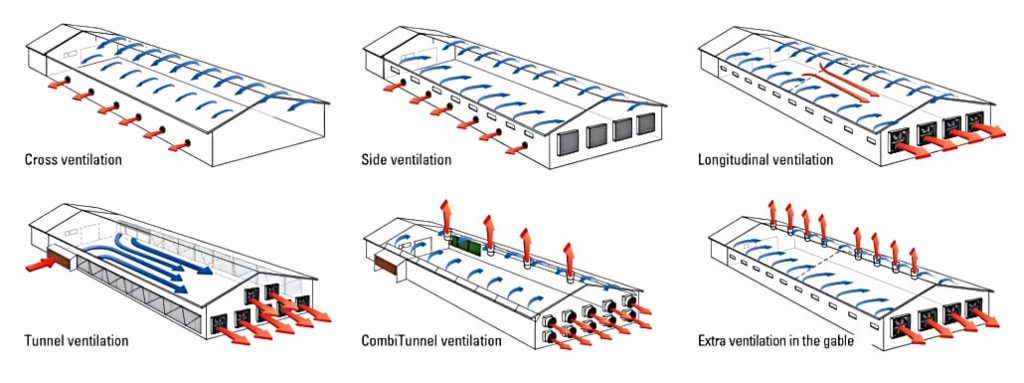
An EC fan pulls air out of the house, creating negative pressure. Fresh air enters through inlets. That air exchange removes heat, moisture, ammonia, CO₂, and dust. In a closed-house system, the fan runs almost constantly. In an open-side house, fans still run during hot periods or when birds are large.
EC fans work in every stage: minimum ventilation (low speed, constant run), transitional, and full tunnel mode (high speed). They replace the old AC fans in the end wall, side walls, or ceiling recirculation loops.
EC fan technology means you can move exactly the air you need, when you need it, using less than half the power of an old AC fan.
How EC Fans Improve Climate Control, Bird Health, and Productivity
What does an exhaust fan actually do on a poultry farm? It removes stale air and pulls in fresh outside air. That simple action:
- Lowers temperature in summer (wind-chill effect)
- Removes moisture so litter stays dry
- Pulls out ammonia and carbon dioxide
- Brings in oxygen
EC fans do all that better because they run at variable speed. A standard AC fan is either on (100% power) or off. An EC fan can run at 30%, 50%, or 70% سرعت.
Summer cooling: Run tunnel fans at high speed to create air movement over birds. The effective temperature drops 6–10°F without any AC.
Winter minimum ventilation: Run a few fans at very low speed (20–30%) just enough to exchange air without chilling the birds. An AC fan at 30% speed wastes energy and may overheat – EC fans stay efficient even at low speeds.
Humidity control: Wet litter leads to footpad lesions and ammonia spikes. EC fans automatically ramp up when humidity sensors trigger, drying the house without blasting cold air.
Health and performance metrics:
- Lower mortality from heat stress and respiratory issues
- Better feed conversion ratio (birds eat less to gain the same weight)
- Higher egg production and shell quality in layers
- More uniform flock weights
Farmers who switch to EC fans routinely report 2–3 point improvements in FCR and 1–2% lower mortality. That’s money in the bank.
EC Fans vs AC, Belt-Driven, Direct-Drive, Wall, Ceiling, and Tunnel Fans
Let’s compare the options you’ll find on a poultry farm.
| تایپ کنید | How it works | Pros | Cons |
| AC fan (old style) | Induction motor, single speed | Cheap to buy | No speed control, poor power factor, wastes energy at partial load |
| Belt-driven AC fan | Motor drives fan via belt | Lower initial cost, easy to replace motor | Belt wears, slips, needs tensioning; lower efficiency |
| Direct-drive EC fan | Motor directly on fan hub, built-in controller | راندمان بالا, سرعت متغیر, low maintenance | Higher upfront cost |
| Wall fan | Mounted in side wall | Good for transitional/minimum ventilation | Not ideal for high-speed tunnel |
| Ceiling recirculation fan | Moves air vertically, breaks stratification | Reduces temperature gradient, keeps floor dry | Doesn’t exchange air, only circulates |
| Tunnel fan | Large fans at one end, pulls air down house length | High airflow for summer cooling | Requires good inlet control |
Advantages of EC fans summarized:
- 30–50% less energy than AC at same airflow
- True variable speed (20–100% range) without efficiency loss
- Lower noise – birds are calmer
- No belts to replace, no capacitors to fail
- Can be controlled by PLC or simple thermostat
Where each fits:
Tunnel ventilation (summer) – EC fans at high speed, often 36″ or 50″ diameter.
Minimum ventilation (winter) – Same EC fans at low speed, or smaller dedicated EC fans.
Circulation – Ceiling EC fans run continuously at very low speed to destratify air.
A mixed system works well: tunnel fans all EC, plus a few small EC wall fans for minimum ventilation.
How to Select and Size EC Fans for Broiler and Layer Houses
This is where most guides get vague. Let’s be specific.
Step 1 – Determine your maximum ventilation rate.
For broilers, you need roughly 0.5 to 1.0 CFM per kg of body weight at peak summer. A common rule: 6–8 CFM per square foot of floor area for tunnel ventilation. For a 40′ x 500′ house (20,000 sq ft), target 140,000–160,000 CFM.
Step 2 – Determine your minimum ventilation rate.
Winter minimum is about 0.1–0.2 CFM per kg, or roughly 10–20% of max. For the same house, 15,000–30,000 CFM.
Step 3 – Select fan models with performance curves.
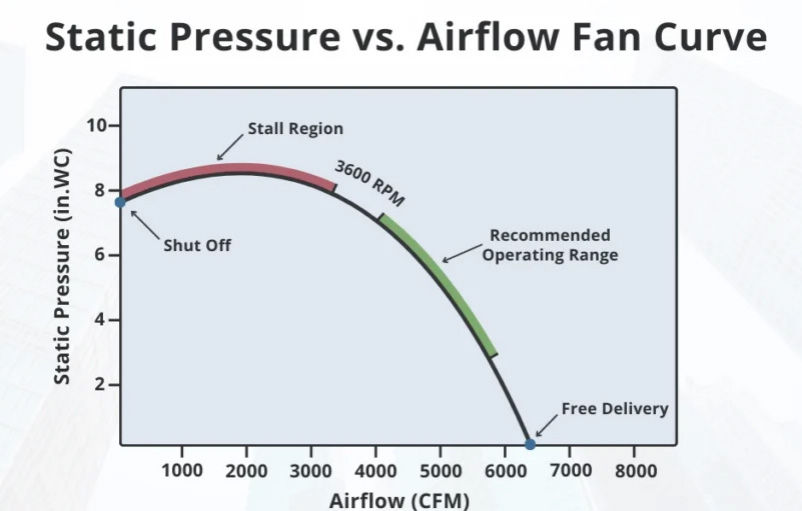
Every EC fan has a published airflow vs static pressure curve. Typical static pressure: 0.08–0.12″ for minimum ventilation, up to 0.20″ for clean tunnel. Check the curve at your operating pressure – some fans drop sharply.
Key specs to compare:
Airflow (CFM at 0.10″ static pressure)
کارایی (CFM per watt)
IP rating– at least IP54 for dusty, humid poultry houses
Corrosion protection – coated blades, stainless steel housings if near salt air or high ammonia
سر و صدا – lower is better for bird welfare
Control compatibility – 0-10V, PWM, or Modbus for central controller
For broiler houses:
- Tunnel fans: 50″ or 54″ diameter, 20,000–30,000 CFM each.
- Minimum ventilation fans: 18″ or 24″ EC fans, 3,000–6,000 CFM.
For layer houses (cage or aviary):
- More fans distributed along the house, smaller diameters (24″ –36″) to avoid drafts on birds.
If you’re not sure, grab a pencil: floor area × target CFM per sq ft = total needed. Divide by fan CFM = number of fans. Add 10–15% margin for dirty pads or worn bearings.
Energy Savings, Smart Controls, ROI و Installation
Energy savings example:
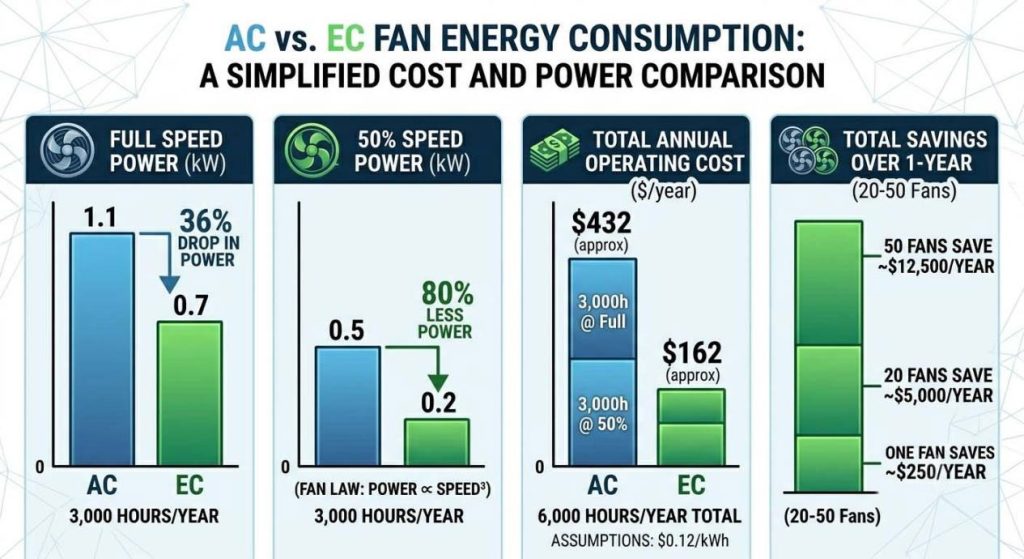
A 36″ AC fan running at full speed pulls about 1.1 kW. The same airflow from an EC fan uses 0.7 kW – a 36% drop. But the real savings come from part-load. در 50% سرعت, the AC fan (if you could run it that slow – many can’t) still draws 0.5 kW and loses efficiency. The EC fan at 50% speed draws about 0.2 kW (fan law: power ∝ speed³). That’s 80% less power for half the airflow.
Run that fan 6,000 hours a year, at $0.12/kWh, half at full speed, half at half speed. AC: roughly $400/year. EC: roughly $150/year. One fan saves $250/year. Multiply by 20–50 fans.
Smart controls:
Connect EC fans to a central climate controller that reads temp, humidity, CO₂, and ammonia. The controller ramps fans up/down automatically. No manual switches. Many EC fans accept 0-10V or Modbus signals.
ROI:
Upfront cost for an EC fan is 1.5–2x an AC fan. Payback is typically 12–24 months from energy savings alone, shorter if you count improved bird performance.
Installation:
Direct-replacement EC fans fit the same hole and mounting as old fans. You may need to run control wiring (low voltage) back to the controller. Most farms do a room-by-room retrofit over a couple of seasons.
Troubleshooting common issues:
- Poor airflow: dirty blades, high static pressure (blocked inlets), or fan spinning wrong direction.
- Wet litter: minimum ventilation rate too low, or fans not running enough during cold weather.
- Birds huddling or spreading: temperature gradient or draft from fans. Adjust fan placement or speed.
Get a Custom EC Fan Solution for Your Poultry House
Every farm is different. House size, bird type, climate, and electricity cost all change the optimal fan setup. A good supplier should:
Calculate your required CFM for max and min ventilation
Provide fan performance curves at your expected static pressure
Estimate energy savings and payback period
Recommend fan placement and inlet sizing
Ensure control compatibility with your existing system (or provide a controller)
Send us a few details and we‘ll send back a fan selection, layout sketch, and ROI estimate:
House dimensions (length, width, ceiling height)
Bird type and max stocking density
Region / typical summer and winter temperatures
Existing fan count and model (if retrofitting)
Your electricity rate (US$ per kWh)
Contact us: info@volcaomotors.com
سوالات متداول
Q1: What is the use of exhaust fan in poultry farm?
A1: Exhaust fans pull stale air out, creating negative pressure. Fresh air enters through inlets. This removes heat, moisture, ammonia, CO₂, dust, and pathogens. It also creates air movement that cools birds in summer.
Q2: What are the advantages of EC fans?
A2: راندمان بالاتر (30–50% less energy), variable speed control without efficiency loss, lower noise, no belts or capacitors, longer life, and easy integration with smart controllers.
Q3: How do EC fans help control temperature and humidity in poultry houses?
A3: They run at variable speed – low for minimum ventilation in winter, high for tunnel cooling in summer. They respond to sensors to keep temperature and humidity within the bird’s comfort zone, reducing heat stress and wet litter.
Q4: Are EC fans better than AC fans for poultry farming?
A4: بله, for most applications. They save energy, allow precise climate control, and improve bird health. The only downside is higher upfront cost, which pays back in 1–2 years.
Q5: How do you select the right EC fan size for a broiler or layer house?
A5: Calculate required CFM for maximum summer ventilation (0.5–1.0 CFM/kg or 6–8 CFM/sq ft). Then choose fans that meet that total at your expected static pressure. Minimum ventilation requires about 10–20% of that CFM. Use fan performance curves, not just manufacturer claims.