Volcano Motor
How Much Does a Evaporative Air Cooler Cooler Really Cost?
If you’re searching for “solar air cooler” or “industrial solar cooling price,” you’re likely comparing options for a factory, warehouse, or farm. You’ve found that prices vary widely, and the technical details are complex. This guide explains the real factors behind the cost, why the system design is more critical than the unit alone, and how an intelligent Photovoltaic Microgrid System delivers superior long-term value and solves the core limitations of traditional solutions.
1. What’s the Real Price of a Evaporative Air Cooler Cooler?
You see online quotes ranging from $100 to over $1,500 per unit. The significant price gap is not just about the cooler itself, but the entire power solution required to run it effectively.
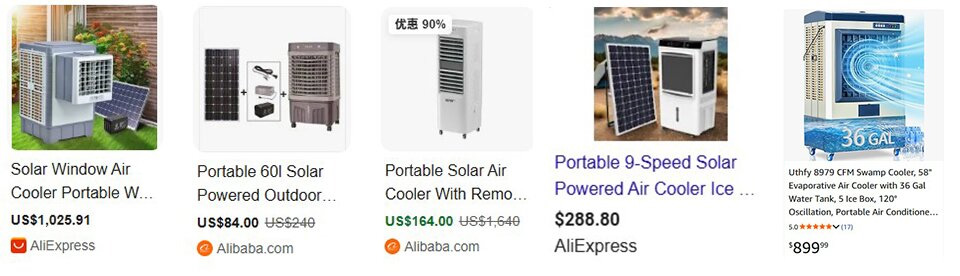
Basic Off-Grid Coolers: A standalone 48V DC cooler may seem affordable initially. However, it necessitates a complete independent system—solar panels, MPPT charge controller, and a large battery bank. This can double or triple the total project cost and adds installation and maintenance complexity.
Simple Hybrid (ACDC) Coolers: These connect to both solar panels and the grid. Their major flaw is the typical “one-to-one” design: one dedicated solar array (often 2-3 kW) powers only one cooler. If that cooler is off, the generated solar energy is wasted. For a facility requiring multiple units, this means duplicating solar investments, leading to high capital expenditure and poor energy utilization.
Therefore, the key question for smart buyers shifts from “unit price” to “total cost of ownership and system efficiency.”
2. How Can New Technology Drastically Reduce Your Total Cost?
The breakthrough lies in moving from isolated units to an integrated Photovoltaic Microgrid. This system connects solar panels, multiple coolers, and optional storage into a smart, private energy network managed by a central Energy Manager (Power Optimizer).
This is particularly transformative for regions with high cooling demand and abundant sunshine. For example, a factory in the Middle East facing extreme heat and high electricity tariffs can achieve remarkable savings:
Shared Solar Investment: Instead of installing separate solar sets for 10 coolers, one larger, centralized solar array powers the entire microgrid. The Energy Manager dynamically directs solar power to wherever cooling is needed most, drastically reducing the required solar panel capacity and upfront cost per cooling unit.
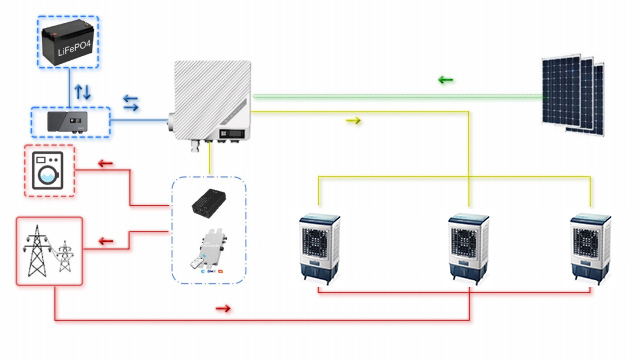
Eliminated Energy Waste: No solar energy is wasted. When cooling demand is low, excess solar power automatically charges a central battery bank. This stored energy then powers the coolers in the evening or during peak grid tariff hours, maximizing self-consumption and slashing electricity bills.

Built-in Reliability: The system provides seamless backup. During a grid outage, the microgrid can continue to power critical cooling loads from solar and storage, ensuring operational continuity.
3. What Are the Core Advantages of Our Microgrid System for Air Cooler?
Our solution, powered by Energy Model-based PINN AI scheduling, is not just an incremental improvement but a generational leap. Here’s how we solve the fundamental pain points:
Unmatched Cost Efficiency & Scalability
Our core advantage is the decoupling of solar generation from individual coolers. One solar array supports an entire network of coolers. This means your initial investment goes much further, and expanding cooling capacity later is simpler and more economical—you primarily add more coolers to the existing smart microgrid, not entirely new solar systems.
Precision Energy Management & Zero Waste
We guarantee that over 98% of the solar energy is consumed directly on-site. Our AI-driven manager performs real-time, second-level energy dispatch, ensuring every available watt is used to power cooling loads or charge batteries. This eliminates the “solar energy waste” inherent in traditional one-to-one hybrid systems.
Architectural Simplicity & Compliance:
Our “front-end hybrid, back-end off-grid” architecture is inherently compliant with stringent grid regulations worldwide. It physically prevents reverse power flow to the grid, avoiding the need for complex external “anti-backfeed” devices and simplifying utility approvals. Installation and wiring are as straightforward as traditional systems.
4. What Should You Ask Your Air Cooler Supplier Before Buying?
To identify a truly economical and energy-efficient solar-powered air coolers, ask these critical questions:
“Can multiple coolers share a single solar investment, or is each unit tied to its own panels?”
“How does your system handle excess solar energy when cooling demand is low? Can it be stored simply for later use?”
“What is your system’s architecture to ensure compliance with local grid regulations against reverse feeding?”
Conclusion: The True Value Lies in the System Intelligence
The most economical and reliable solar cooling solution is an intelligent microgrid. For forward-thinking buyers, the choice is clear: investing in our integrated Photovoltaic Microgrid System translates to lower capital expenditure, minimal operational waste, guaranteed energy reliability, and a scalable path for the future.
Contact Eternal for a personalized system analysis and see how our intelligent microgrid delivers superior value compared to conventional solar cooling approaches.