 Vulkanmotor
Schlitz vs. Nutenlose Motoren: Welches tatsächlich zu Ihrer Anwendung passt??
You’re specifying a brushless motor. Auf dem Papier sieht die Drehmomentdichte gut aus, but you’re worried about cogging at low speed. Oder Glätte ist entscheidend, but you can’t sacrifice too much torque.
This is the slotted vs. slotless decision – and it’s one of the most fundamental choices in BLDC motor selection.
Here’s what you actually need to know to make that decision.
What’s Actually Different Inside?
The difference comes down to one thing: the stator.
Slotted motors have iron teeth with copper coils wound around each tooth. The teeth concentrate magnetic flux, giving you higher torque density. The air gap is small – typically 0.3-0.8mm. This is the traditional BLDC design, and it’s still the most common.
Slotless motors have no teeth – just a smooth iron ring with self-supporting windings held in place by resin. The air gap is larger (0.5-2mm), but the magnetic field is uniform and linear. No teeth means no cogging.
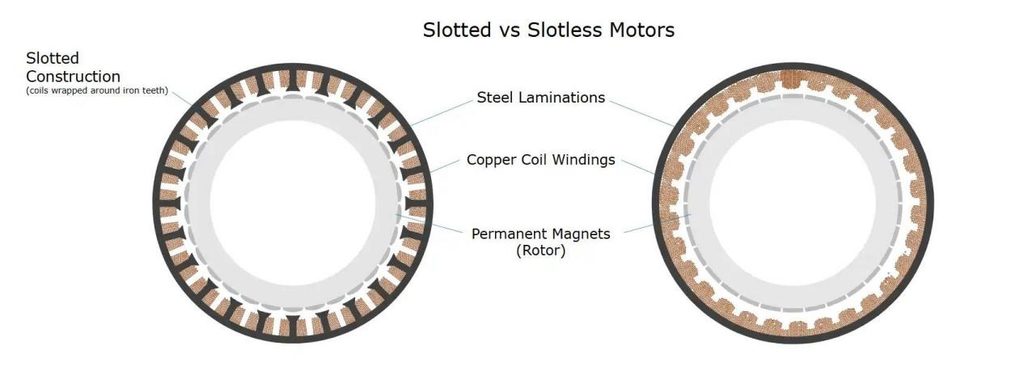
Why this matters: A slotted motor can deliverbis zu 52.6% higher average torque than a slotless motor of the same volume. But those teeth create cogging torque – A “detent” effect where the rotor tries to align with the stator teeth. Slotless motors eliminate this entirely.
Typical dimensions: Slotted slot openings range from 1-3mm for small motors up to 5-10mm for larger frames. Slotless air gaps typically run 0.5-2mm, compared to 0.3-0.8mm for slotted designs.
Where Each Motor Actually Wins
Drehmomentdichte
Slotted wins. The teeth concentrate flux and allow more copper in the same volume. A slotted motor can deliverbis zu 52.6% higher average torque than a slotless motor of the same size. For applications that need high torque in a compact package – industrial servos, actuators, power tools – slotted is the clear choice.
Slotless motors trade torque density for smoothness. They typically deliver about75% of the rated torque of a comparable slotted motor.
Cogging Torque
Slotted motors have cogging torque. It typically ranges from1–5% of rated torque depending on the design. This creates torque ripple – the motor “cogs” at discrete positions as the magnets try to align with the teeth. At low speed, you feel every jerk.
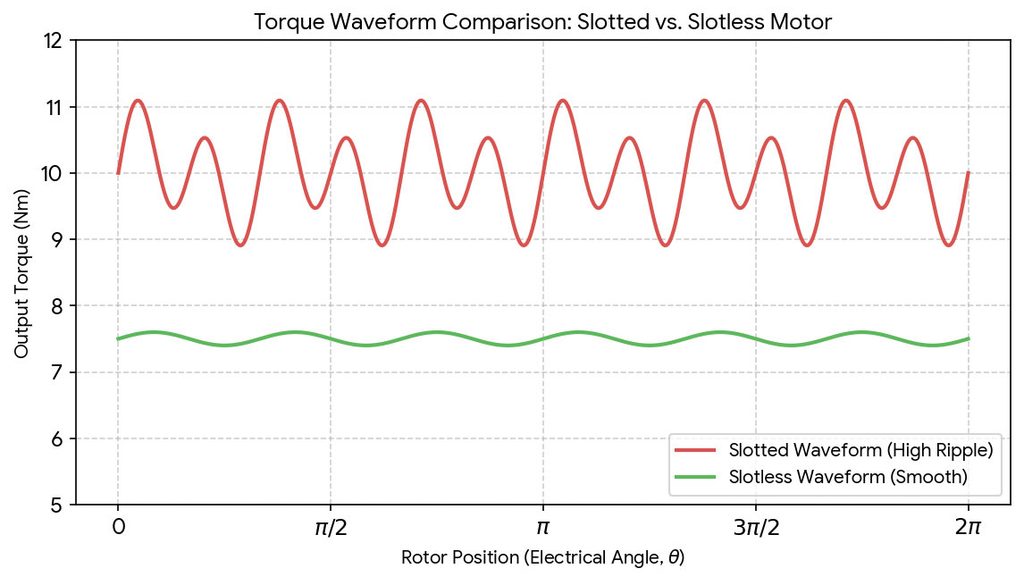
Slotless motors havezero cogging torque. No teeth means no reluctance variation. The motor runs smooth from zero speed up.
Back-EMF and Harmonics
Slotted motors have higher back-EMF harmonic distortion due to slot effects. The teeth create spatial harmonics that distort the waveform. Slotless designs achieve torque ripple approximately 31% lower than slotted designs, mittotal harmonic distortion (THD) reduced by about 20%.
Slotless motors produce cleaner, more sinusoidal back-EMF – which translates to smoother torque and easier control.
Effizienz
Efficiency depends on your operating point.
Slotted motors havehigher iron losses – eddy currents and hysteresis from the teeth. Slotless motors havehigher winding losses because the windings are in the air gap with less effective cooling.
At high speed, iron losses in slotted motors grow significantly – slotless motors often pull ahead. At low to medium speed with high torque, slotted motors are generally more efficient. Run your numbers at your actual operating point.
The Heat Problem Nobody Talks About
This is where the two designs diverge in real operation.
Slotted motors embed windings within the iron core, creating a direct thermal path from the copper to the housing. Heat conducts out efficiently – higher continuous current capability. For heavy thermal loading – continuous-duty industrial applications – slotted designs are preferred.
Slotless motors have windings in the air gap, farther from cooling surfaces. Heat transfer is less efficient. Jedoch, some slotless designs enable embedded cooling architectures – liquid cooling within the winding support structure.
Key thermal limits:
Isolierklasse: Klasse F (155°C) is standard. Class H (180°C) for higher-temperature environments.
Magnet temperature: NdFeB magnets start demagnetizing above 150-180°C.
Winding temperature: Slotless windings may run hotter at the same current due to poorer heat transfer. Derating is often required for continuous operation.
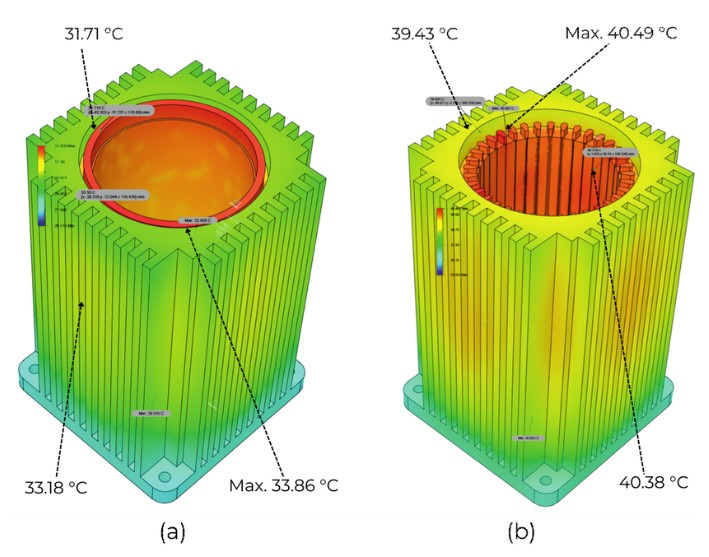
Simplified thermal check: Measure temperature rise at rated load after thermal stabilization. If winding temperature exceeds insulation class limits, reduce load, improve cooling, or move to a larger frame size.
What It Costs to Build Each One
The manufacturing differences are substantial.
Slotted motors use stacked steel laminations with stamped teeth. Windings are inserted into the slots – a well-established, automated process. Lower cost at scale.
Slotless motors require precision coil forming and placement. Self-supporting winding structures are more complex to manufacture. Prototype costs are typically higher. Jedoch, the stator core is simpler – no teeth to stamp.
Cost drivers:
Slotted: Lamination stamping, winding insertion, insulation materials
Slotless: Precision coil winding, resin encapsulation, larger/stronger magnets (to compensate for the larger air gap)
Lead times: Slotted motors are faster to produce in volume – mature, automated processes. Slotless prototypes take longer due to custom winding tooling.
How to Control, Test, and Tune Each Type
Control Considerations
Slotless motors have very low inductance– no iron in the magnetic path. Current can change very quickly – excellent for dynamic response, but challenging to control. Low inductance requires higher PWM frequencies– typically 50-100 kHz instead of the standard 8-20 kHz – to minimize current ripple.
Slotted motors have higher inductance, which smooths current ripple naturally. Standard PWM frequencies work fine.
Tuning tips for slotless: Start with lower current loop gains and increase gradually. Use higher PWM frequency. Consider adding a small series inductor if ripple is excessive.
Testing and Measurement
Standard test protocol for comparing prototypes:
- Torque-speed curve – constant voltage, record torque vs. speed at multiple points
- Torque ripple – torque transducer at constant current, measure peak-to-peak as percentage of average
- Back-EMF – spin at constant speed (unpowered), record phase-to-phase voltage, calculate THD
- Acoustic noise – measure sound pressure level at 1m in a semi-anechoic chamber
- Effizienz – measure input power and output power at multiple load points
Real-World Case Study
Case 1 – Surgical hand tools (Portescap): Orthopedic tools need high torque for drilling dense bone – slotted motors are preferred for their torque density. Cranial tools operate at 80,000-100,000+ RPM where smooth, low-vibration rotation is critical – slotless motors are the choice.
Case 2 – High-speed BLDC motors: A comparative study of slotted and slotless high-speed motors up to 480 krpm found that each topology has advantages in different speed ranges. Slotted motors have higher power density but higher loss density at extreme speeds. The choice depends on the specific speed and thermal requirements.
Case 3 – Blood pump application: Slotless motors showed reduced size, diminished speed fluctuations, and faster speed response – but almost double the power consumption and higher temperature rise compared to slotted motors. This trade-off is acceptable in some medical applications where smoothness is more critical than efficiency.
Quick Decision Guide
| If you need… | Choose… |
| High torque density in a compact package | Slotted |
| Zero cogging, ultra-smooth at low speed | Slotless |
| High-speed operation (>50,000 U/min) | Slotless |
| Continuous duty with high thermal load | Slotted |
| Quiet operation (noise-sensitive environment) | Slotless (5 dB quieter) |
| Cost-sensitive, high-volume production | Slotted |
| Schnelle dynamische Reaktion | Slotless (low inductance) |
| General industrial servo / automation | Slotted (proven, cost-effective) |
Still not sure? Send your torque, Geschwindigkeit, duty cycle, and noise limit to your motor supplier and ask for both options with real performance data – not just marketing claims. Run your numbers and pick the one that eliminates your specific problem.
Das Fazit
Slotted motors give you more torque per dollar and per cubic inch. They’re the workhorse of industrial automation. If your application runs at medium speed with moderate torque requirements and cost matters, start here.
Slotless motors give you smoothness and zero cogging. They’re the precision tool for applications that can’t tolerate vibration. If you need ultra-smooth low-speed operation, quiet running, or high speed, slotless is worth the premium.
There’s no universal “besser” – only what fits your application. Use the decision guide above, run your numbers, and pick the one that eliminates your specific problem.
Need help deciding? Our engineering team can review your requirements and recommend the right topology with real performance data.
Contact us: info@volcanomotors.com
FAQ
Q1: How much higher is the torque density of slotted motors compared to slotless?
A1: Slotted motors can deliverbis zu 52.6% higher average torque than slotless motors of the same volume – typically 30-50% in practice.
Q2: Which motor is quieter?
A2: Slotless.Bis zu 5 dB quieter because there are no teeth to create magnetic noise.
Q3: Which motor is better for high-speed operation?
A3: Slotless. Lower iron losses at high speed make them more efficient above 50,000 U/min.
Q4: Which motor costs less?
A4: Slotted. Manufacturing is mature and automated – lower cost, faster lead times.
Q5: Which applications are best for slotted vs. slotless?
A5: Slotted: Industrial servos, actuators, power tools, Pumps, Fans – where torque density and cost matter. Slotless: Surgical robots, medizinische Geräte, aerospace actuators, gimbals, metrology – where smoothness, zero cogging, and low noise are critical.