 Volcano Motor
BLDC vs PMSM: Which One is Better for Your Application?
BLDC motors and PMSMs represent two sides of the same coin. Both types utilize permanent magnets and synchronous operation. However, they differ primarily in control methods and back-EMF waveforms.
Academic Definitions: BLDC as a Type of PMSM
Classification of Permanent Magnet Synchronous Motors
Permanent magnet synchronous motors (PMSMs) are categorized based on their rotor design and magnetic field generation. The two primary subtypes include:
- Surface Permanent Magnet (SPM) Motors: In these motors, permanent magnets attach to the rotor’s surface. This design simplifies construction and enhances torque density.
- Interior Permanent Magnet (IPM) Motors: Here, permanent magnets are embedded within the rotor. This configuration improves performance by optimizing the magnetic field distribution.

Both types utilize permanent magnets to create a constant magnetic field, which interacts with the stator’s rotating magnetic field generated by AC electricity. While BLDC motors share similar construction with PMSMs, they differ mainly in their back EMF waveform characteristics.
Origin of the Term ‘BLDC’
The term “brushless DC motor” (BLDC) emerged to describe motors that operate without brushes, which are common in traditional DC motors. BLDC motors typically generate a trapezoidal back EMF due to their specific winding configurations. This term highlights the motor’s operational characteristics rather than its structural similarities to PMSMs.

Academic Perspectives on Their Relationship
Academic researchers often debate the relationship between BLDC motors and PMSMs. Many consider BLDC motors a specific implementation of PMSM technology. The following table summarizes key distinctions and similarities:
| Aspect | BLDC Motor | PMSM Motor |
| Back-EMF waveform | Trapezoidal | Sinusoidal |
| Current excitation | Quasi-square wave currents | Sinusoidal currents |
| Rotor magnets | Permanent magnets on rotor | Permanent magnets on rotor |
| Commutation | Electronic (no brushes) | Electronic (no brushes) |
| Control methods | Sensorless techniques based on back-EMF sensing | Sensorless techniques based on back-EMF sensing |
| Performance advantages | Better speed-torque characteristics, high efficiency, reliability, suitability for safety-critical applications | High efficiency, smooth torque due to sinusoidal excitation |
| Classification | Considered a subset or specific implementation of PMSM technology | General category including BLDC as a type |
This evidence supports the notion that while BLDC motors and PMSMs share fundamental design features, their operational characteristics and control strategies set them apart.
Structural Differences
Rotor and Stator Construction
Both BLDC and PMSM motors share significant structural similarities, particularly in their rotor and stator designs. But differences exist in their stator constructions. The table below outlines key distinctions:
| Component | BLDC Motor | PMSM Motor |
| Stator | Stationary part with windings | With 3-phase AC windings |
| Rotor | Rotating part with permanent magnets | Permanent magnets on or inside rotor |
| Power Source | DC Power Supply | AC Power Source / Inverter |
Winding Configurations: Concentrated vs Distributed
Winding configurations play a crucial role in the performance of both motor types. BLDC motors often use concentrated windings, while PMSMs typically employ distributed windings.

The following table summarizes the advantages and disadvantages of each winding type:
| Winding Type | Advantages | Disadvantages |
| Concentrated Windings | Simpler construction and lower cost. | Can lead to choppy torque output with non-matching ESCs, causing noise and inefficiency. |
| Distributed Windings | Produces sinusoidal back EMF, leading to smoother operation. | More complex construction and typically higher cost. |
Back EMF Waveforms: The Fundamental Technical Difference
What is Back EMF
Back EMF, or back electromotive force, is a critical concept in electric motor operation. It refers to the voltage generated by a motor’s rotor as it spins within a magnetic field. This voltage opposes the applied voltage, hence the term “back.”
In BLDC motors, the back EMF typically exhibits a trapezoidal shape. This waveform results from the specific winding configurations used in these motors. Conversely, PMSM motors generate a sinusoidal back EMF, which is smoother and more continuous. The shape of the back EMF waveform significantly influences the motor’s operational characteristics, including torque production and efficiency.
Trapezoidal vs Sinusoidal Waveforms
The distinction between trapezoidal and sinusoidal waveforms is fundamental to understanding the performance differences between BLDC and PMSM motors.

Trapezoidal Waveform:
- Found in BLDC motors.
- Simpler control algorithms lead to easier implementation.
- However, this waveform results in torque ripple and reduced torque production.
Sinusoidal Waveform:
- Characteristic of PMSM motors.
- Allows for smoother motion and maximum torque production.
- Requires more complex control algorithms but enhances overall performance.
BLDC motors, with their trapezoidal back EMF, generate discrete torque pulses. This characteristic can lead to higher torque ripple, increased noise, and reduced efficiency, especially at lower speeds. In contrast, PMSM motors produce smooth and continuous torque due to their sinusoidal back EMF. This design minimizes torque ripple and enhances efficiency across various operating conditions.
Impact of Waveform Shape on Motor Behavior
The shape of the back EMF waveform plays a crucial role in determining the overall behavior of both BLDC and PMSM motors. The following points highlight the impact of waveform shape:
Torque Ripple:
- BLDC motors experience higher torque ripple due to their trapezoidal back EMF. This can lead to vibrations and noise during operation.
- PMSM motors, with their sinusoidal back EMF, produce smoother torque, resulting in quieter operation.
Efficiency
- The trapezoidal back EMF in BLDC motors can lead to reduced efficiency, particularly at lower speeds. The discrete nature of the torque output can hinder performance.
- In contrast, the sinusoidal back EMF in PMSM motors allows for better matching of the drive current, enhancing efficiency across a wider range of speeds.
Control Complexity:
- BLDC motors benefit from simpler control strategies due to their trapezoidal waveform. However, this simplicity comes at the cost of performance.
- PMSM motors require more sophisticated control methods, such as field-oriented control, to fully exploit their sinusoidal back EMF advantages.
Control Methods and Their Evolution
Traditional Control: Six-Step vs Sinusoidal PWM
BLDC motors often use six-step commutation, which drives the motor with square-wave currents. This method relies on low-resolution Hall sensors to detect rotor position and uses simple commutation logic. The speed regulation range remains narrow due to the discrete nature of the control.
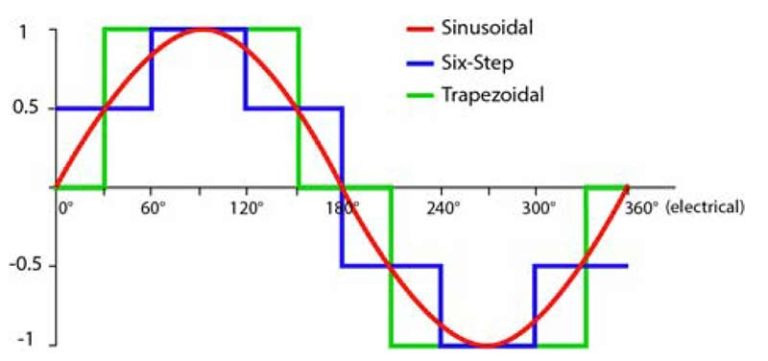
In contrast, PMSM motors typically employ sinusoidal pulse-width modulation (PWM). This approach drives the motor with sinusoidal currents, requiring high-resolution encoders or resolvers for precise rotor position feedback. The control algorithms involve complex vector control techniques, allowing a wide speed regulation range and smoother operation.
| Aspect | Six-Step Commutation (BLDC Motor) | Sinusoidal PWM (PMSM) |
| Driving Method | Square-wave driving | Sinusoidal-wave driving |
| Position Sensor | Low-resolution Hall sensors | High-resolution encoders/resolvers |
| Control Algorithm | Simple commutation logic | Complex vector control algorithms |
| Speed Regulation Range | Narrow | Wide |
Modern Trends: Field Oriented Control and Cross-Control Techniques
Field-oriented control (FOC) has become the dominant strategy for PMSM motors. FOC optimizes torque production and speed control by precisely aligning the stator current with the rotor magnetic field. This method improves torque stability and efficiency, especially in applications like electric vehicles that face varying loads and terrains.
Recent advances include real-time adaptive control strategies. These techniques monitor motor parameters continuously and adjust control algorithms dynamically. Such adaptability enhances responsiveness and performance for both BLDC and PMSM motors under diverse operating conditions.
Blurring Lines Between BLDC and PMSM Control
Modern control methods increasingly blur the operational distinctions between BLDC and PMSM motors. The adoption of FOC and adaptive controls allows BLDC motors to achieve smoother torque and better efficiency, traditionally associated with PMSMs. Meanwhile, PMSMs benefit from simplified control schemes in some applications, reducing cost and complexity.
Performance Comparison
Efficiency Differences
PMSM motors generally achieve higher efficiency levels than BLDC motors. The sinusoidal current control in PMSMs allows better alignment between the stator current and rotor magnetic field, minimizing losses. BLDC motors, while efficient, usually operate within a slightly lower efficiency range due to their trapezoidal waveform and simpler control methods.
| Motor Type | Efficiency Range |
| BLDC | 85% – 90% |
| PMSM | 92% – 97% |
PMSMs can reach efficiencies up to 97%, making them suitable for applications demanding energy savings and high performance. BLDC motors remain a cost-effective choice where slightly lower efficiency is acceptable.
Noise and Vibration Considerations
Noise and vibration often correlate with torque ripple and motor control methods. BLDC motors tend to produce more audible noise and mechanical vibrations because of their discrete torque pulses. These effects can be noticeable in quiet environments or precision machinery. PMSM motors, with their smooth torque output and sinusoidal current, operate more quietly and with less vibration. This characteristic makes PMSMs preferable in applications requiring low noise levels, such as medical devices or high-end consumer electronics.
Application Scenarios of BLDC Motor and PMSM
Cost-Sensitive and Power-Dense Applications (BLDC)
BLDC motors excel in cost-sensitive and power-dense applications. The following table highlights key sectors that frequently utilize BLDC motors:
| Industry | Application Description |
| Automotive | Significant driver of innovation, used in Electric Vehicles (EVs) and various subsystems. |
| Aerospace | Provides precise control and high power density for manned and unmanned flight. |
| Industrial Automation | Enable precise and reliable motion in smart manufacturing. |
| Medical Technology | Requires absolute reliability and precision, often for portable medical devices. |
| Consumer Electronics | Enhances performance and efficiency in everyday products. |
These applications benefit from the compact size and lightweight nature of BLDC motors, making them suitable for devices where space and weight are critical.
Precision and Smoothness Priority Applications (PMSM)
PMSM motors are preferred in applications where precision and smoothness are paramount. The following table outlines common application areas for PMSM motors:
| Application Area | Description |
| Industrial Machinery | Used in CNC machines, robots, and conveyor systems for precise motion control. |
| Electric Vehicles (EVs) | Serves as power sources for battery-operated trains and small electric vehicles, enhancing efficiency. |
| Direct-Drive Systems | Applied in electromechanical actuators and wind turbines, simplifying design by eliminating gears. |
| High-Performance Motorcycles | Equipped in motorcycles like the Bikonit Raptor BK-28 for quick response and energy efficiency. |
PMSMs are increasingly favored in high-precision applications such as CNC machines and medical devices. In CNC machines, they provide the necessary precision for accurate cutting, milling, and drilling, which is crucial in manufacturing and aerospace. In the medical field, the reliability and accuracy of motors are vital for the performance of diagnostic tools, surgical robots, and medical pumps.
Overlapping Use Cases
While BLDC and PMSM motors serve distinct purposes, some applications benefit from both types. For instance, both motor types find use in electric vehicles, where efficiency and performance are critical. Additionally, they can be employed in robotics, where torque smoothness and power density are essential. This overlap allows engineers to select the most suitable motor based on specific project requirements, balancing cost, performance, and application needs.
Decision Guide: Choosing Between BLDC and PMSM
Selecting between BLDC and PMSM motors involves evaluating several key factors. Here are essential considerations to guide the decision-making process:
Application Requirements:
- Torque Smoothness: Choose PMSM for applications needing smooth torque, such as CNC machines or medical devices.
- Cost Sensitivity: Opt for BLDC motors in budget-constrained projects, like consumer electronics or hobby-grade applications.
Performance Needs:
- Efficiency: PMSMs generally offer higher efficiency, making them ideal for energy-sensitive applications.
- Torque Ripple: BLDC motors may produce higher torque ripple, which can affect performance in precision tasks.
Control Complexity:
- Simplicity: BLDC motors use simpler control methods, making them easier to implement in less demanding applications.
- Advanced Control: PMSMs require more sophisticated control strategies, suitable for high-performance environments
Size and Weight:
- Compact Design: BLDC motors often have a smaller footprint, beneficial for portable devices.
- Power Density: PMSMs provide higher power density, making them suitable for applications where space is limited but performance is critical.
Noise and Vibration:
- Quieter Operation: PMSMs operate more quietly, making them preferable in noise-sensitive environments.
- Higher Noise Levels: BLDC motors may generate more noise due to their torque ripple.
By weighing these factors, engineers can make informed decisions that align with their project goals. Understanding the strengths and weaknesses of each motor type will lead to better performance and efficiency in the final application.
FAQ
What is the main difference between BLDC and PMSM motors?
BLDC motors generate trapezoidal back EMF, while PMSM motors produce sinusoidal back EMF. This difference affects their efficiency, torque smoothness, and noise levels.
Are BLDC motors more cost-effective than PMSM motors?
Yes, BLDC motors typically have a simpler design and lower manufacturing costs, making them more cost-effective for budget-sensitive applications.
How do control methods differ between BLDC and PMSM motors?
BLDC motors often use simpler six-step commutation, while PMSM motors utilize more complex sinusoidal PWM and field-oriented control for better performance.
Looking for a reliable motor partner? Whether you need a standard BLDC or a high-performance PMSM, we’ll help you select or design the ideal solution. Contact us at info@volcanomotors.com to get started immediately.